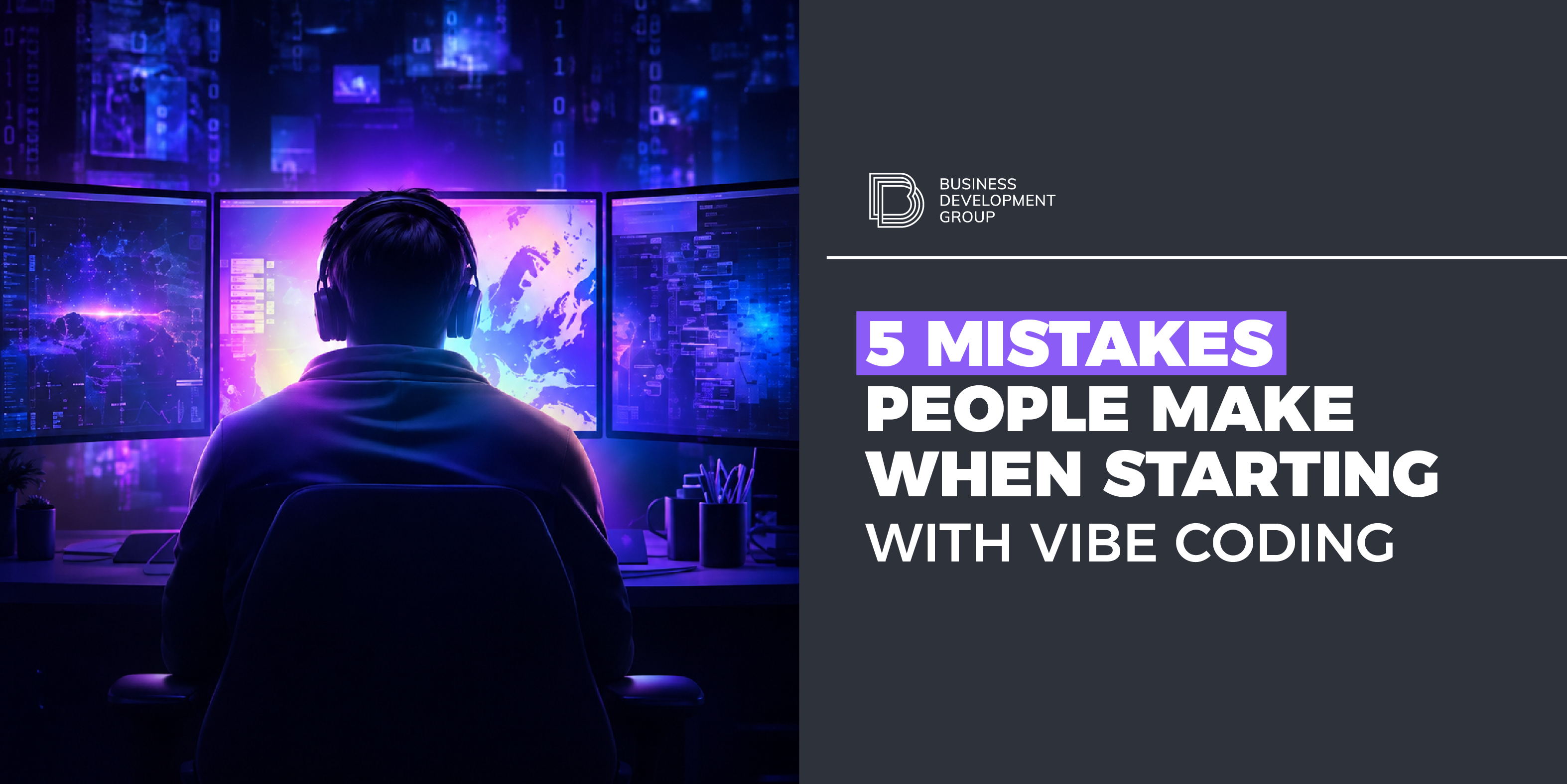
Vibe coding, describing software intent in natural language and letting an AI generate the implementation, has changed how teams prototype and ship. Tools such as Cursor, Replit, Lovable, Claude Code, and GitHub Copilot have lowered the barrier to producing working code dramatically. But working code is not the same as production-ready code. The gap between the two is where beginners consistently run into trouble.
AI Code Governance exists to close that gap. It is the layer of review, policy enforcement, and automated quality control that transforms AI-generated output into software a CTO, CISO, or platform architect can trust in production. Without it, every mistake on this list becomes a live risk before a sprint review is complete.
Here are eight of the most common mistakes beginners make when vibe coding, and what responsible practice looks like at each stage.
1. Accepting code without reading it - the fastest route to invisible technical debt is to paste AI-generated code into a codebase without reviewing it line by line. The code may compile and pass a superficial test, but if you cannot explain what it does, you cannot debug it, maintain it, or extend it. This is the direct route to a black-box codebase: code that runs until it does not, and nobody knows why. Every block of AI-generated code must be read before it is merged. If a section is unclear, ask the AI to explain it. If the explanation is also unclear, the implementation needs simplification before it moves forward.
2. Using vague, overloaded prompts - prompt quality is the single largest driver of output quality. Beginners frequently start with broad intent, “build me a customer portal”, and receive broad, tangled output that is difficult to validate or extend. The AI cannot infer unstated constraints: your data model, access control rules, naming conventions, or existing architecture. Decompose every feature into its smallest meaningful unit, describe inputs, outputs, and constraints explicitly, and treat each prompt as a written specification rather than verbal shorthand.
3. Skipping edge cases and error handling - AI-generated code is optimized for the happy path. It handles valid inputs and expected flows reliably. What it routinely omits is what happens when a user submits an empty form, a network request times out, an external API returns a 500 error, or an integer field receives a string. These gaps do not surface in initial testing. They appear in production, under real conditions, at the worst possible moment. After any generation task, explicitly prompt for failure modes: empty inputs, network failures, unexpected data types, and concurrent request handling.
4. Ignoring security until it is too late - security is consistently the costliest mistake vibe coders make. AI generation tools produce recurring vulnerability patterns: hardcoded credentials committed to source control, missing input sanitization, SQL injection vectors, overly permissive access controls, and placeholder secrets left in production configurations. These pass superficial review because the code is syntactically correct and appears to work. Security review cannot be deferred to a later sprint. Automated static analysis must run on every commit, and human review must follow any AI-generated authentication, authorization, or data-handling logic.
5. Introducing hallucinated or unverified dependencies - AI models sometimes suggest packages that do not exist, have been abandoned, or have been deliberately registered by attackers to match common AI hallucination patterns, a technique known as slopsquatting. A developer who accepts a dependency suggestion without verifying it against the official package registry can inadvertently introduce malicious code. Every suggested library must be confirmed as actively maintained, correctly licensed, and free from known vulnerabilities.
6. Building complexity before validating the foundation - a common pattern among beginners is generating multiple interconnected features before testing any of them. The AI produces code that looks complete; the developer keeps prompting for more. By the time something fails, and something always fails; the root cause is buried under layers of unvalidated code. Build incrementally: generate one functional unit, test it to destruction, confirm it behaves as specified, then move to the next. The instinct to keep generating is exactly the habit that produces the most unmaintainable codebases.
7. Losing code ownership - production software requires an owner: someone who understands how it works, can diagnose failures, extend it as requirements change, and explain its behavior to an auditor. Vibe-coded applications deployed without that ownership create technical debt that cannot be paid down without rebuilding from scratch. When a production incident occurs at 3 am, the absence of ownership is not an inconvenience; it is an outage that nobody can resolve. Every AI-generation session should produce a written record of architectural decisions made, constraints applied, and known limitations of the output. Future maintainers depend on that context.
8. Treating the AI Tool as a compliance substitute - AI coding assistants do not know your organization’s regulatory obligations. They will generate code that appears complete while omitting audit trails, access controls, data retention policies, and explain ability requirements that compliance mandates. Regulatory compliance cannot be retrofitted. It must be embedded from the first-generation cycle, which requires a governance layer: enforced rules, automated checkpoints, and systematic review of every AI-generated artefact.
Vibe coding can dramatically accelerate software development, but speed alone does not make code secure, scalable, or production-ready. The most serious risks emerge when teams accept AI-generated output without understanding, testing, verifying, and documenting it.
Responsible vibe coding requires clear prompts, incremental development, thorough testing, security checks, verified dependencies, compliance controls, and clear human ownership. This is where AI Code Governance becomes essential: it ensures that every AI-generated artefact meets the technical, security, and regulatory standards required for production.
The goal is not to generate more code faster, but to create software that teams can confidently understand, maintain, and trust. AI may write the implementation, but accountability must always remain human.