Design
·Offline New
Design Systems Advanced
- ✓ Fundamentals of Visual Language
- ✓ Design Tokens and Variables
- ✓ Principles of Component Architecture
- ✓ Applying Design Systems in Practice
Free consultation · Certificate on completion · Practical learning
Duration
2 months
Format
Offline
Level
Expert
Starts
27.09.2025
Certificate
On completion
Price
79,000 ֏
Program
- Embracing scalability in design
- Systems thinking and design at scale
- The real value of design systems
- When not to use a design system and why that’s OK
- Dispelling myths: “Systems kill creativity” and other misconceptions
- How and when to start a design system
- Stakeholder interviews and system discovery
- Defining system scope vs. product scope
- Designing the systems team: roles, responsibilities
- Visual inventory exercise: identifying reusable patterns
- Crafting your v1.0 Design System
- Color system: base colors, usage guidelines, semantic roles
- Typography system: type scales, hierarchies, styles
- Spacing & sizing rules
- Visual imagery: icons, illustrations, images
- Visual form: border radius, shadows, depth
- Motion & sound basics
- What are design tokens? Benefits and formats
- Token architecture
- Working with variables in Figma
- Foundation Tokens: Color tokens
- Foundation
- Typography tokens and rules
- Shape and radius system
- Spacing strategies (internal vs external spacing)
- Layout structure and grid systems
- Elevation layers (depth and shadows)
- Accessibility
- Balancing flexibility and restriction in components
- Theming & multi-brand design considerations
- Anatomy of a component
- Start with basics: button and link
- Text Input
- Text Area
- Label
- Avatar
- Divider
- Breadcrumbs
- Checkbox
- Radio Button
- Toggle
- Tabs
- Slider (range input)
- Badge vs. Tag
- Notification (Toast/Snackbar)
- Progress indicators
- Stepper
- Components
- Tooltip
- Popover
- Modal
- Sheet (Drawer)
- Accordion
- Focus: Z-index strategies, animation, focus traps, keyboard navigation
- Components:
- Navigation
- Select
- Dropdown
- Menu
- Components:
- Card
- List
- Data Table
- Pagination
- Empty states, error states, loading states
- Performance impact of heavy components
- Creating a pilot team and MVP component set
- Versioning and release strategy
- Performance considerations: design vs code
- Communicating breaking changes
- Growing adoption through education and internal champions
- What is great design system documentation?
- Writing documentation people actually read
- Templates for component pages
- Choosing the right tools (Notion, Zeroheight, Storybook, etc.)
- Voice and tone for documentation
- Understanding the structure of front-end systems
- How design tokens go to code (Style Dictionary, Tokens Studio sync)
- Inspecting code: what’s helpful to know as a designer
- Git basics, version control, and changelogs
- Working in design-engineering squads
- How to define success in a design system?
- Common KPIs: adoption, reuse rate, time-to-deliver, contribution ratio
- Tools for tracking: Amplitude, analytics, surveys, design usage
- Early signs your system is breaking down
Each participant/team presents their system:
- Foundations
- Components
- Documentation
- Pilot rollout or concept
- Peer review and feedback
- Final Q&A, reflection, and discussion of next steps
Why Join the Course?
Why Join the “Advanced Design Systems Course”?
Design systems aren’t just about documentation or tokens; they’re about creating better products at scale. In this course, we go beyond theory to teach you how to build, evolve, and lead design systems that actually work in real product environments. You’ll learn how to manage complexity, collaborate effectively with developers, drive adoption, and maintain system health, gaining the skills and mindset needed to deliver real impact.- Bridge Design and Code - Learn how to align your system with development teams to reduce friction and accelerate workflows.
- Design for Scale - Discover how to build systems that grow with your product, not against it.
- Lead with Strategy - Understand how to make your design system a strategic asset, not just a side project.
- Real-World Insights - Gain practical, no-fluff lessons from someone who has implemented systems at scale.
- Long-Term Impact - Learn how to drive adoption, manage contribution models, and make your system part of the company culture.
Get 5% Cashback
Pay with  QR Code
- 1 Pay the tuition by bank transfer in your own name.
- 2 Receive the electronic settlement document confirming the payment.
- 3 File your annual income declaration and include the tuition expense.
- 4 Once approved, the amount is refunded to your bank account.
Who is this course for
-
✓
Mid-Senior Product Designers
For experienced Product Designers proficient in Figma who aim to gain design system skills or advance their career in this direction by becoming a Design Systems Engineer.
-
✓
Other Designers
Open to designers who want to acquire design system development skills to enhance their team’s performance.
Ready to join this course?
Secure your place and take the next step in your professional growth.
Frequently asked questions
Each course is labelled beginner, intermediate or advanced. If you are unsure, book a free consultation and we will help you choose.
Flexible payment options are available for most programs. Contact us to discuss the right plan for you.
We mostly hold trainings with a Project Based Learning approach. Thanks to this approach, the students gain practical knowledge and develop their proficiency in the most efficient way.
After each training the students pass exams. Thus, both students and trainers have the opportunity to clearly assess the effectiveness of the training. Based on the results of the exams the students get certificates.
Upon completion of the training we give certificates to our students. Moreover, those whose performance is above 80% receive certificates of excellence.
We have developed a partner network that includes current best employers. In cooperation with them we do our best to assist our students in finding jobs. This network also helps us to organise internships for our students after the trainings.
Payment for the courses is made after the first lesson until the second lesson, in cash or by transfer. Payment for each stage is made for a fixed amount of 8 lessons.
Our courses are held in 2 main formats: online and offline. We believe that maintaining the format is very important for the effectiveness of the course.
BDG classrooms are technically equipped, and if necessary, we also provide students with laptops.
There is a break during each course, during which you can have a coffee and tea break.
HR consulting is carried out with our Career Development Specialist. With him, you can discuss your CVs, make corrections and finalize them, ready to apply for jobs.
All course materials, including recordings, books provided by trainers and other educational materials, are constantly available to our students during the course.
Individual courses are not currently designed, based on market needs and demands. During group courses, participants are also actively involved in teamwork, develop their communication skills, and learn to work in a team.
There is no age limit as such, as we value the spread of education to all age groups. It is especially important for us that people who already have experience and knowledge and want to acquire a new profession also go into a new educational direction.
Admission to each course is carried out through an interview or a test, or both at the same time. The choice of admission method depends on the requirements and specifics of the course.
We provide technical support to all our students related to the operational work of computers, as well as technical issues. The support is provided by our employee within the framework of the course.
Our team is in constant contact with students to provide the information you need, if necessary.
Certificates
Certificates you can receive
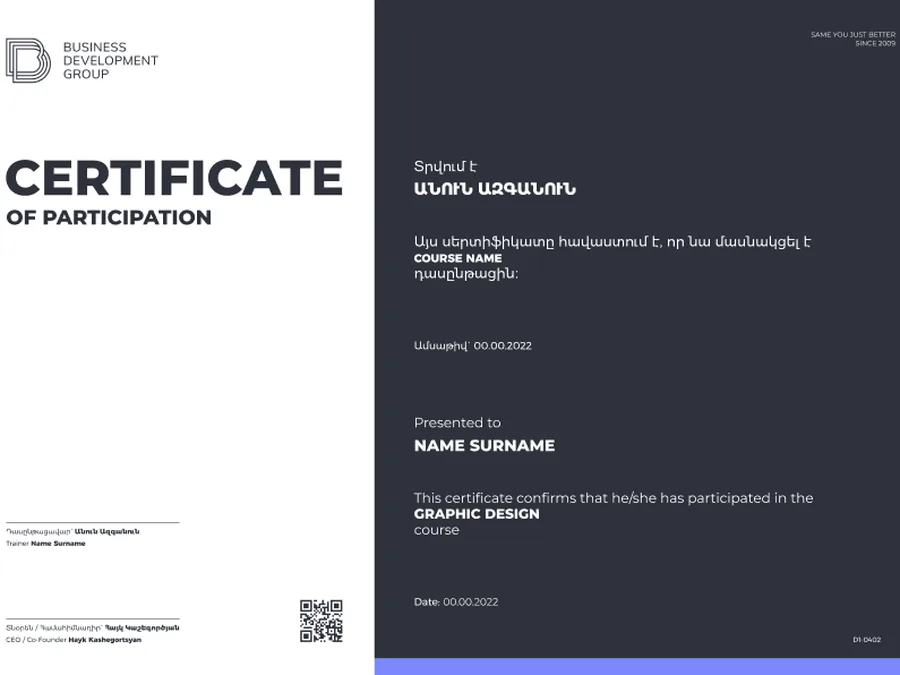
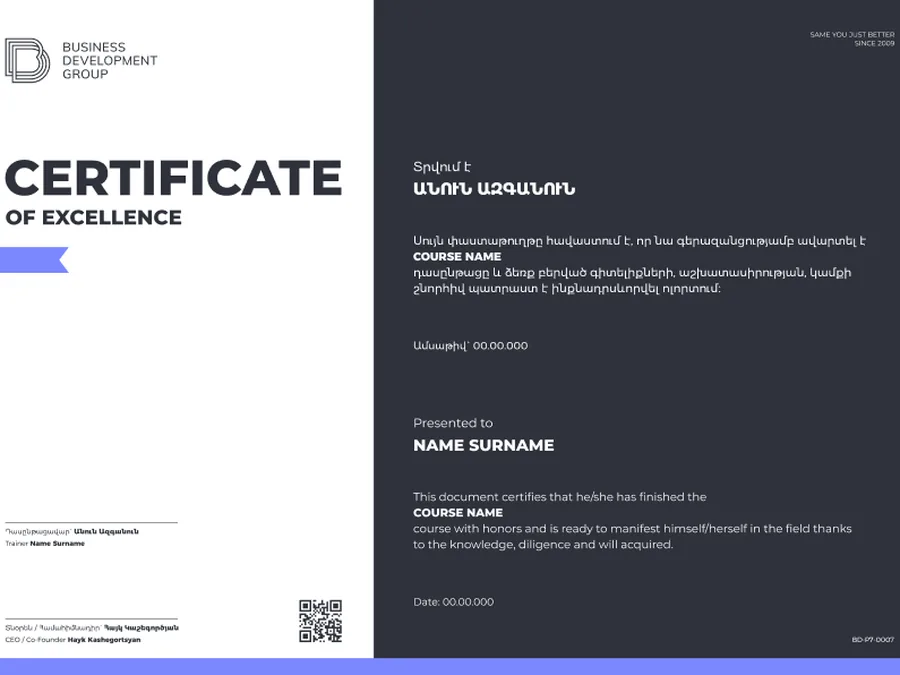
Depending on the course format and results, students can receive one of BDG's certificate types.
- ✓ Verified BDG certificate
- ✓ QR / signature-ready format
- ✓ Armenian & English certificate design
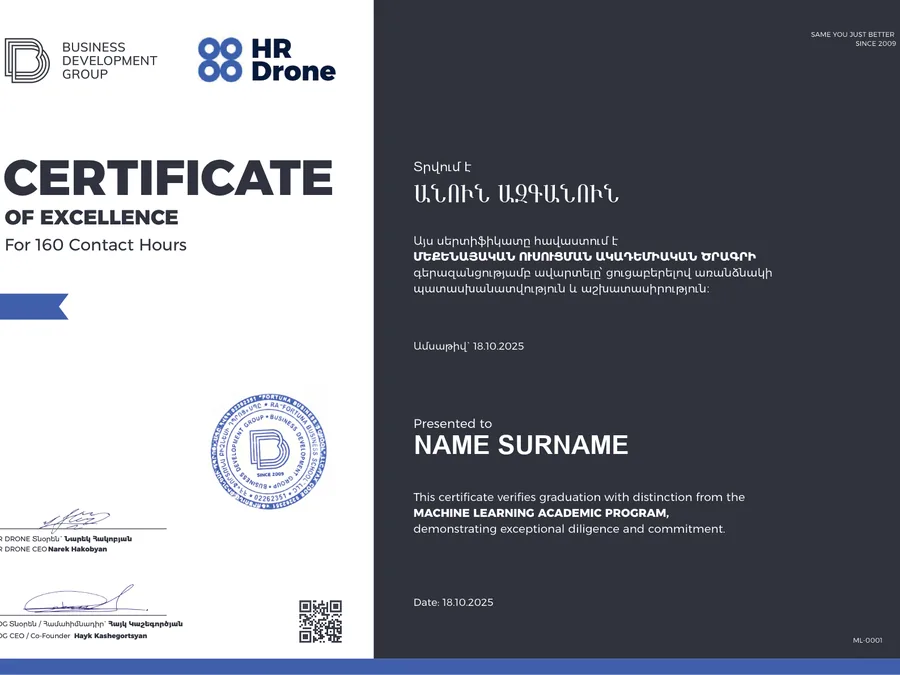 Co-branded
Participation
For students who actively participate in the course learning process.
For active participationCompletion
For students who complete the course requirements and finish the program.
For successful completionExcellence
For students who complete the course with outstanding results and strong performance.
With distinctionHR Drone
A co-branded certificate for selected HR and partner-certified programs.
Co-brandedDesign
Ready to start Design Systems Advanced?
Book a free consultation and reserve your place in the next cohort.
79,000 ֏
2 months · Starts — September 27, 2025
Keep exploring
Related courses