
Management
·Offline
Advanced Project Management: AI Powered
- ✓ Applying PMI standards in practice
- ✓ Estimation, scheduling, and project control
- ✓ Risk, procurement, and vendor management
- ✓ Stakeholder engagement, project governance, and change
Free consultation · Certificate on completion · Practical learning
Duration
2 months
Format
Offline
Level
Advanced
Starts
31.10.2026
Certificate
On completion
Lessons
16 lessons
Price
75,000 ֏ / month
Schedule
- Tuesday · 19:00–21:30
- Saturday · 11:00–13:30
Internship opportunity
Art Goes Agile
Top-performing students may receive an internship opportunity with Art Goes Agile.
Program
- Understand the course structure, the assessment model, and what the capstone will require of you
- Explore what changed in PMBOK® 8; six principles, seven performance domains, and five Focus Areas with 40 adaptable processes
- Score your own live project against the seven performance domains, and identify your two weakest
- Compare predictive, agile and hybrid approaches, and learn to defend a tailoring decision to a sponsor who has already chosen
- Agree the ground rules for working with real project material, including client confidentiality
- Set your personal objective for the course around your diagnostic result
- Hands-on Practice
- How to write a project charter that authorises rather than decorates?
- How to define success criteria that can actually be measured when the project closes?
- Build and maintain a requirements traceability matrix on your own project
- Understand the boundary between scope creep and legitimate change
- Document assumptions and constraints so they survive a change of team
- How can AI accelerate requirements analysis without inventing requirements?
- Hands-on Practice
- Apply analogous, parametric and three-point (PERT) estimation to your own work
- How to present an estimate as a range with a confidence level instead of a single number
- Distinguish contingency reserve from management reserve, and know who owns each
- Build a schedule network; read critical path, total float and free float
- Compare crashing and fast-tracking, and calculate what each one actually costs
- Apply resource levelling and smoothing under real capacity limits
- Hands-on Practice
- Calculate PV, EV and AC from your own project data
- Interpret CV, SV, CPI and SPI and understand what each of them hides
- Forecast with EAC, ETC, VAC and TCPI, and choose the formula that fits your situation
- What to tell a sponsor when CPI falls below 1, and when to escalate
- Build an EVM tracker you can maintain weekly without it becoming a second job
- How can AI speed up EVM reporting while keeping every number auditable?
- Hands-on Practice
- Run qualitative analysis: probability and impact, scoring, prioritisation
- Apply quantitative methods: expected monetary value, decision trees, and Monte Carlo in concept
- Build a risk register the team actually opens and updates
- Choose response strategies, avoid, transfer, mitigate, accept, escalate, and manage opportunities, not only threats
- Govern reserve drawdown without losing the sponsor's confidence
- How can AI support risk identification without generating false confidence?
- Hands-on Practice
- Make-versus-buy decisions and procurement planning
- Compare fixed-price, time-and-materials and cost-reimbursable contracts, and the risk each transfers
- Run a procurement from requirements through RFP to award
- Define SLAs and acceptance criteria for work you do not perform yourself
- Manage vendor performance, and handle a supplier who is already behind
- Understand procurement compliance and audit expectations in corporate and donor-funded environments
- Hands-on Practice
- Map stakeholders by power, interest and attitude; and keep the map current
- How to manage up, and how to deliver bad news early enough to matter?
- Rehearse difficult conversations: the deadline that will be missed, the failing vendor, the scope the client will not pay for
- Negotiate scope, budget and time when you hold no formal authority
- Understand team development, motivation and conflict inside delivery teams
- Coach junior project managers, and give feedback that changes behaviour
- Design project governance: steering committee, decision rights, escalation paths
- Run RAID discipline so risks, assumptions, issues and dependencies stay live
- Build a status report an executive reads to the end
- Operate formal change control: request, impact analysis, decision, baseline update
- Understand organisational change and adoption — and treat resistance as information
- How can AI help trace the ripple effects of a change across a complex project?
- Written paper follows this lesson, covering Modules 1 and 2
- Understand the difference between a workflow, where you define the steps, and an agent, where the model chooses them
- Why the simplest approach that works is almost always the right one
- Map five documented automation patterns onto real PM tasks: chaining, routing, parallelisation, orchestration, and draft–critique–revise
- Learn the operating loop behind all of them: gather context → act → verify → repeat
- Audit your own week and identify which parts are worth automating — and which are not
- Hands-on Practice
- Why context is a budget, and how to find the smallest set of high-signal information that gets the result?
- Build a project memory file, pruned by one test: would removing this line cause a mistake?
- Package a repeatable procedure as a reusable skill your assistant loads when relevant
- Connect an assistant to the systems where your project work already lives
- Apply the prompting essentials that carry the most weight: be explicit, give the reasoning, use canonical examples, structure long inputs
- How to instruct for edits and actions rather than suggestions
- Hands-on Practice
- Build a weekly status report assembled from updates scattered across chat, mail and your tracker
- Turn a real meeting into decisions, actions and new risks, filed into the tracker with owners and dates
- Score a real vendor bid or CV comparison against criteria you define first
- Learn the refinement discipline: test on two or three items before running across all of them
- Recognise the failure modes, invented progress, inferred owners, flattering scores, and fix the instruction rather than the output
- Choose which of the three becomes your assessed automation artifact?
- Build an evaluation set from 20–50 of your own real failures
- Grade the end state rather than the explanation; why a fluent summary of the wrong actions is the worst possible output
- Measure consistency, not only whether something worked once
- Apply the reversibility and impact test before leaving any automation unattended
- Know where the human stays: work affecting other teams, sensitive data, and anything sent in your name
- Understand client confidentiality, and what a project manager must never hand over
- Hands-on Practice
- Distinguish KPIs from OKRs, and leading indicators from lagging ones
- Apply flow metrics — throughput, cycle time and work in progress
- Plan benefits realisation, and run the post-implementation review nobody runs
- Prioritise across a portfolio under fixed capacity, and manage cross-project dependencies
- Understand what a PMO is actually for
- Guest Speaker Session: Data Analytics Coach
- Supervised assembly of your artifact portfolio, with the trainer working the room
- Review each artifact against the assessment rubric before it is graded
- Understand the PMP®, CAPM® and PMI-ACP® pathways: eligibility, contact hours, application and exam strategy
- Know what changed in the PMP® exam from July 2026 and what it means for your preparation
- Position your portfolio, your automation and your experience on a CV and in interviews
- Present your capstone in full to your pair group
- Give and receive structured critique against the rubric
- Learn to defend a decision under questioning without becoming defensive
- Revise your artifacts and your automation on the feedback
- Rehearse the fifteen-minute format and its timing
- Fifteen-minute defence before a panel: your project artifacts, your automation, and the reasoning behind both
- Answer questions from the panel and from invited guests from local industry
- Receive final assessment and individual feedback
- Certificates awarded on attendance, the written paper, the automation artifact and the capstone defence
Why Join the Course?
By the end of the course, participants will be able to:
- Apply PMBOK® 8 principles to a real project and justify their choice of management approach,
- Develop a project charter with measurable success criteria,
- Estimate timelines and budgets, track progress, and forecast outcomes using real data,
- Assess risks, justify contingency reserves, and manage procurement and vendor performance,
- Manage stakeholder engagement, reporting, and change control,
- Build and test an AI automation for a recurring task, while understanding its limits,
- Use a set of project management templates and defend a portfolio of practical work, explaining the decisions behind it.
Get 5% Cashback
Pay with  QR Code
- 1 Pay the tuition by bank transfer in your own name.
- 2 Receive the electronic settlement document confirming the payment.
- 3 File your annual income declaration and include the tuition expense.
- 4 Once approved, the amount is refunded to your bank account.
Who is this course for
-
✓
Project managers and Project Coordinators
Professionals with around 2-6 years of experience who want to advance their careers, manage complex projects with greater confidence, and support their decisions with data.
-
✓
Previous management course participants
Anyone who has completed an introductory project management course at BDG. BDG graduates are eligible for a 20% discount on this course.
-
✓
Professionals working alongside project managers
Coordinators, business analysts, team leads, and agency account managers who already handle some project management responsibilities and are ready to take on more.
-
✓
Managers
Team and delivery leaders who oversee project managers and want to establish shared project management approaches and standards across their teams.
What you will learn
- ✓Applying PMI standards in practice
- ✓Estimation, scheduling, and project control
- ✓Risk, procurement, and vendor management
- ✓Stakeholder engagement, project governance, and change
- ✓Applying AI throughout project delivery
- ✓Metrics, benefits realization, and the capstone project
Ready to join this course?
Secure your place and take the next step in your professional growth.
Trainer

Mariam Chtchyan
COO / Program Manager
Mariam Chtchyan is the Chief Operating Officer (COO) of HackTech, with over 9 years of experience as a Program and Delivery Manager. She began her career as a Junior Project Manage...
Frequently asked questions
Each course is labelled beginner, intermediate or advanced. If you are unsure, book a free consultation and we will help you choose.
Flexible payment options are available for most programs. Contact us to discuss the right plan for you.
We mostly hold trainings with a Project Based Learning approach. Thanks to this approach, the students gain practical knowledge and develop their proficiency in the most efficient way.
After each training the students pass exams. Thus, both students and trainers have the opportunity to clearly assess the effectiveness of the training. Based on the results of the exams the students get certificates.
Upon completion of the training we give certificates to our students. Moreover, those whose performance is above 80% receive certificates of excellence.
We have developed a partner network that includes current best employers. In cooperation with them we do our best to assist our students in finding jobs. This network also helps us to organise internships for our students after the trainings.
Payment for the courses is made after the first lesson until the second lesson, in cash or by transfer. Payment for each stage is made for a fixed amount of 8 lessons.
Our courses are held in 2 main formats: online and offline. We believe that maintaining the format is very important for the effectiveness of the course.
BDG classrooms are technically equipped, and if necessary, we also provide students with laptops.
There is a break during each course, during which you can have a coffee and tea break.
HR consulting is carried out with our Career Development Specialist. With him, you can discuss your CVs, make corrections and finalize them, ready to apply for jobs.
All course materials, including recordings, books provided by trainers and other educational materials, are constantly available to our students during the course.
Individual courses are not currently designed, based on market needs and demands. During group courses, participants are also actively involved in teamwork, develop their communication skills, and learn to work in a team.
There is no age limit as such, as we value the spread of education to all age groups. It is especially important for us that people who already have experience and knowledge and want to acquire a new profession also go into a new educational direction.
Admission to each course is carried out through an interview or a test, or both at the same time. The choice of admission method depends on the requirements and specifics of the course.
We provide technical support to all our students related to the operational work of computers, as well as technical issues. The support is provided by our employee within the framework of the course.
Our team is in constant contact with students to provide the information you need, if necessary.
Certificates
Certificates you can receive
Depending on the course format and results, students can receive one of BDG's certificate types.
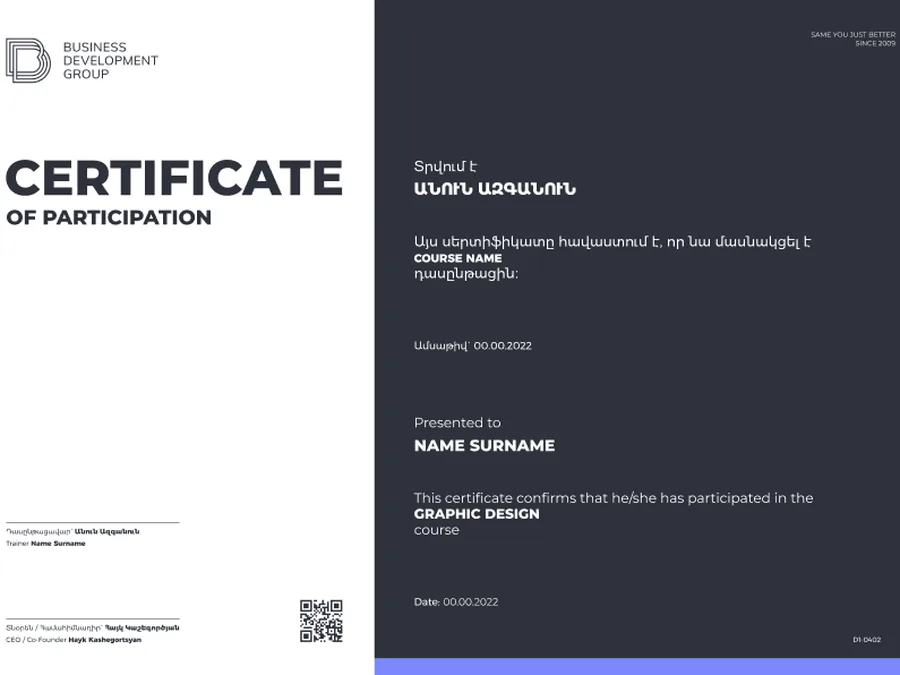
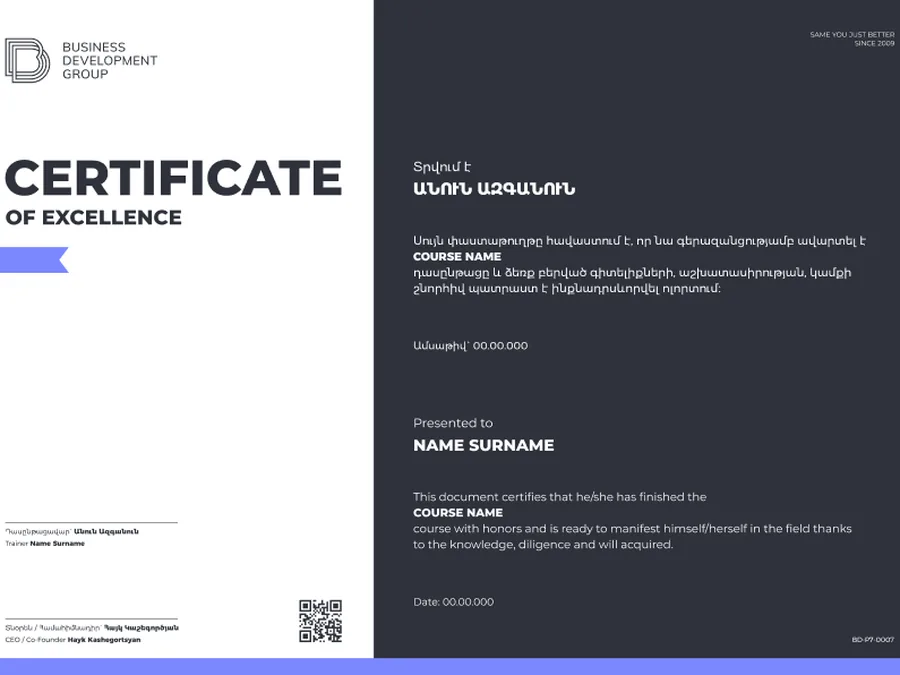
- ✓ Verified BDG certificate
- ✓ QR / signature-ready format
- ✓ Armenian & English certificate design
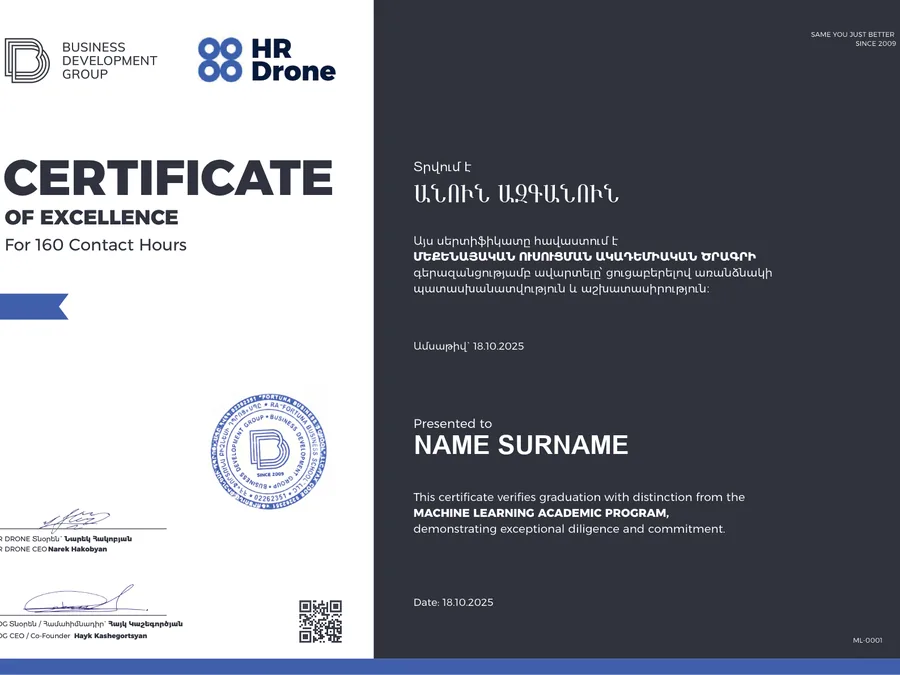 Co-branded
Participation
For students who actively participate in the course learning process.
For active participationCompletion
For students who complete the course requirements and finish the program.
For successful completionExcellence
For students who complete the course with outstanding results and strong performance.
With distinctionHR Drone
A co-branded certificate for selected HR and partner-certified programs.
Co-brandedManagement
Ready to start Advanced Project Management: AI Powered?
Book a free consultation and reserve your place in the next cohort.
75,000 ֏
/ month
2 months · Starts — October 31, 2026
Internship opportunity88% booked
Keep exploring
Related courses
New
Management
2 months
•
Offline
Agile Project Management
Starts 17.12.2026
66% booked
Internship opportunity