 New
Management
·Offline
Agile Project Management Essentials
- ✓ Agile, Waterfall methodologies
- ✓ Scrum and Kanban Frameworks
- ✓ Roadmaps and Story Mapping
- ✓ Metrics and Risk Management
Free consultation · Certificate on completion · Practical learning
Duration
2 months
Format
Offline
Level
Beginner
Starts
30.07.2026
Certificate
On completion
Payment
Monthly
Lessons
16 lessons
Price
65,000 ֏ / month
Schedule
- Thursday · 19:00–21:30
- Saturday · 11:00–13:30
Admission to the course is based on an interview.
Program
- Project definitions
- What creates the demand for projects?
- Prioritization and selection of projects
- Who is the Project Manager? Evolution of the modern Project Manager
- Project Management Terminology
- How AI is changing the nature of projects (automation, AI products, data-driven initiatives)
- Project Management Methodologies: Waterfall
- Waterfall application in the Projects: need & possibilities
- Fixed Mindset vs. Growth Mindset
- What is Agile? Understanding the Agile
- When Waterfall still makes sense for AI & data projects (regulation, model validation)
- Agile Manifesto: Understanding the Values
- Agile Deep Dive: 12 Principles of Agile
- Benefits of using Agile
- Challenges and limitations of Agile
- Agile values in AI teams (experimentation, fast feedback, model iteration)
- Agile Development Lifecycle introduction
- Agile Frameworks: Scrum
- Scrum Values: Why they are important.
- Concepts of Iteration Development, Sprints
- Sprinting with AI uncertainty (model tuning, data dependency, spikes)
- Scrum workflow
- Scrum Events/Artifacts and work with them
- Scrum Roles: Who is who in Scrum? Deep dive into Roles
- Scrum challenges and limitations
- Communication with Team/Stakeholders: Do’s and Don’ts
- Intro to XP: practices and pairing with Scrum
- Role shifts in AI teams (PM, Data Scientist, ML Engineer, AI Product Owner)
- Product vs. Project: How to differentiate them
- Product Owner vs. Project Manager
- Product Backlog: Living Document
- User Story: Anatomy of perfect requirement
- Writing Perfect User Stories: INVEST technique
- Prioritization Techniques: The MoSCoW Method, RICE method
- Writing AI-ready user stories (data, model behavior, non-deterministic outcomes)
- What is Lean?
- 5 Lean Principles
- Lean: Limitations & Challenges
- Lean Frameworks: Kanban, Scrumban
- Lean thinking for AI experiments (build–measure–learn with models)
- Kanban: Intro & Four Basic Principles
- Main players in Kanban: Difference with Scrum
- Kanban Board
- Kanban Deep Dive: WIP & Queue Limits
- Bottlenecks: exploring & handling
- Identifying AI bottlenecks (data labeling, training time, infra constraints)
- Requirements preparation & planning in Project Management
- Product Roadmap: Steps to build a buy-in Roadmap
- MVP concepts: What to include
- Epics concepts
- AI roadmaps (PoC → Pilot → Production, model maturity stages)
- User Stories splitting: various techniques (Spidr, CRUD split)
- Story Mapping: Breakdown and validation
- Documentation Management: Confluence, Notion, etc.
- Task Management tools: Jira, Asana, Trello
- Using AI tools for documentation, backlog refinement, and summarization
- Using AI assistants to generate, split, and refine user stories (with human validation)
- Story Points: Concept & Fibonacci sequence
- Story Point vs Hours: pros & cons
- Agile Estimations: Planning Poker & processes
- T-Shirt Estimation, Complexity Buckets & other methods
- Estimating AI work (research spikes, uncertainty buffers)
- Kanban Estimations
- Kanban processes & meetings
- Kanban Metrics: Cycle Time, Lead Time
- Cumulative Flow Diagram
- Metrics that don’t work well for AI, and what to track instead
- Acceptance Criteria introduction
- Definition of Done: Stricting as the project evolves
- Behavior Driven Development
- Project Budgeting: Traditional Method
- Acceptance criteria for AI (accuracy, confidence, explainability)
- Agile Budgeting: Blended Rate & Labor Method
- Role of Project Manager in budget reporting
- Risk Management in Project Management: Waterfall vs Agile
- Introduction to Team Management: Tuckman Ladder
- AI-specific risks (bias, data quality, model drift, legal exposure)
- Definition of bug: Working with defects
- Handling bugs in Scrum, Kanban
- Regression Testing, Unit Testing & Automation testing concepts
- How to control Average Bug age
- Bugs vs model errors, hallucinations, and retraining triggers
- Agile Metrics: Why they are important and how to use them
- Velocity concept: why, how, and when to use it
- Sprint Burndown Chart
- Engineering Metrics: Commits, Active Days and Ratios
- OKR concept
- AI performance metrics (precision, recall, drift indicators) for PMs
Exam includes AI-aware scenarios and decision-making questions for Project Managers
Why Join the Course?
Why participate in the "Agile Project Management Essentials" course?
Agile project management methodologies are now widely used not only in the IT sector but also across many traditional industries. As a result, the global demand for Agile Project Managers continues to grow steadily.If you’ve decided to learn Agile PM and start your journey in the IT field, the "Agile Project Management Essentials" course is designed for you.
Throughout the course, you will learn the core principles of Agile and its key frameworks. The program is fully practice-oriented, allowing you to reinforce your knowledge and apply it in real-life scenarios.
In response to today’s market demands, the curriculum also includes artificial intelligence, along with relevant professional tools and techniques. During the course, you will explore the role of AI in Agile Project Management, learn how to apply essential techniques, understand AI-related risks, and work with performance metrics.
You will also gain a solid foundation in Agile Project Management, study the principles of the Agile Manifesto, and work with frameworks such as Scrum, Kanban, and others, as well as a variety of practical tools. In parallel, you will develop the essential soft skills required for a Project Manager. Hands-on sessions will ensure that your knowledge is reinforced throughout the course.
By the end of the program, you will be prepared to apply for Junior Agile Project Manager positions.
Get 5% Cashback
Pay with  QR Code
- 1 Pay the tuition by bank transfer in your own name.
- 2 Receive the electronic settlement document confirming the payment.
- 3 File your annual income declaration and include the tuition expense.
- 4 Once approved, the amount is refunded to your bank account.
Who is this course for
-
✓
For beginner
The course does not require any professional knowledge as it is a beginner’s level. You need motivation, hard work, and a desire.
-
✓
Tech sphere professionals
For Tech professionals from other fields who aim to change their career or simply develop skills by learning Project Management.
What you will learn
- ✓Agile, Waterfall methodologies
- ✓Scrum and Kanban Frameworks
- ✓Roadmaps and Story Mapping
- ✓Metrics and Risk Management
- ✓Communication skills
- ✓Team and project management skills
- ✓Role of AI in the Agile Project Management
Ready to join this course?
Secure your place and take the next step in your professional growth.
Trainer

Mariam Chtchyan
COO / Program Manager
Mariam Chtchyan is the Chief Operating Officer (COO) of HackTech, with over 9 years of experience as a Program and Delivery Manager. She began her career as a Junior Project Manage...
Frequently asked questions
Each course is labelled beginner, intermediate or advanced. If you are unsure, book a free consultation and we will help you choose.
Flexible payment options are available for most programs. Contact us to discuss the right plan for you.
We mostly hold trainings with a Project Based Learning approach. Thanks to this approach, the students gain practical knowledge and develop their proficiency in the most efficient way.
After each training the students pass exams. Thus, both students and trainers have the opportunity to clearly assess the effectiveness of the training. Based on the results of the exams the students get certificates.
Upon completion of the training we give certificates to our students. Moreover, those whose performance is above 80% receive certificates of excellence.
We have developed a partner network that includes current best employers. In cooperation with them we do our best to assist our students in finding jobs. This network also helps us to organise internships for our students after the trainings.
Payment for the courses is made after the first lesson until the second lesson, in cash or by transfer. Payment for each stage is made for a fixed amount of 8 lessons.
Our courses are held in 2 main formats: online and offline. We believe that maintaining the format is very important for the effectiveness of the course.
BDG classrooms are technically equipped, and if necessary, we also provide students with laptops.
There is a break during each course, during which you can have a coffee and tea break.
HR consulting is carried out with our Career Development Specialist. With him, you can discuss your CVs, make corrections and finalize them, ready to apply for jobs.
All course materials, including recordings, books provided by trainers and other educational materials, are constantly available to our students during the course.
Individual courses are not currently designed, based on market needs and demands. During group courses, participants are also actively involved in teamwork, develop their communication skills, and learn to work in a team.
There is no age limit as such, as we value the spread of education to all age groups. It is especially important for us that people who already have experience and knowledge and want to acquire a new profession also go into a new educational direction.
Admission to each course is carried out through an interview or a test, or both at the same time. The choice of admission method depends on the requirements and specifics of the course.
We provide technical support to all our students related to the operational work of computers, as well as technical issues. The support is provided by our employee within the framework of the course.
Our team is in constant contact with students to provide the information you need, if necessary.
Certificates
Certificates you can receive
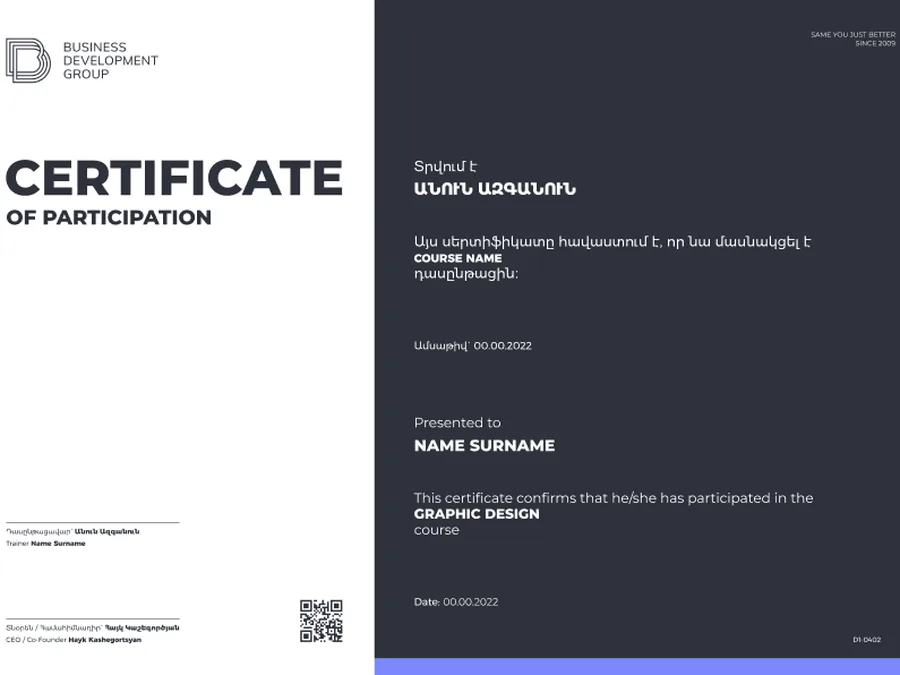
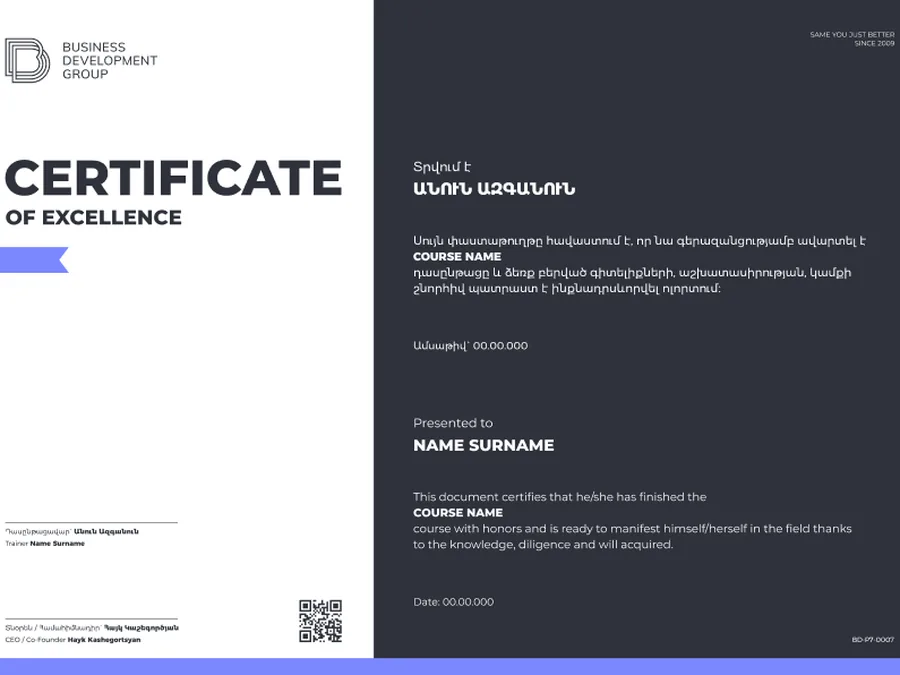
Depending on the course format and results, students can receive one of BDG's certificate types.
- ✓ Verified BDG certificate
- ✓ QR / signature-ready format
- ✓ Armenian & English certificate design
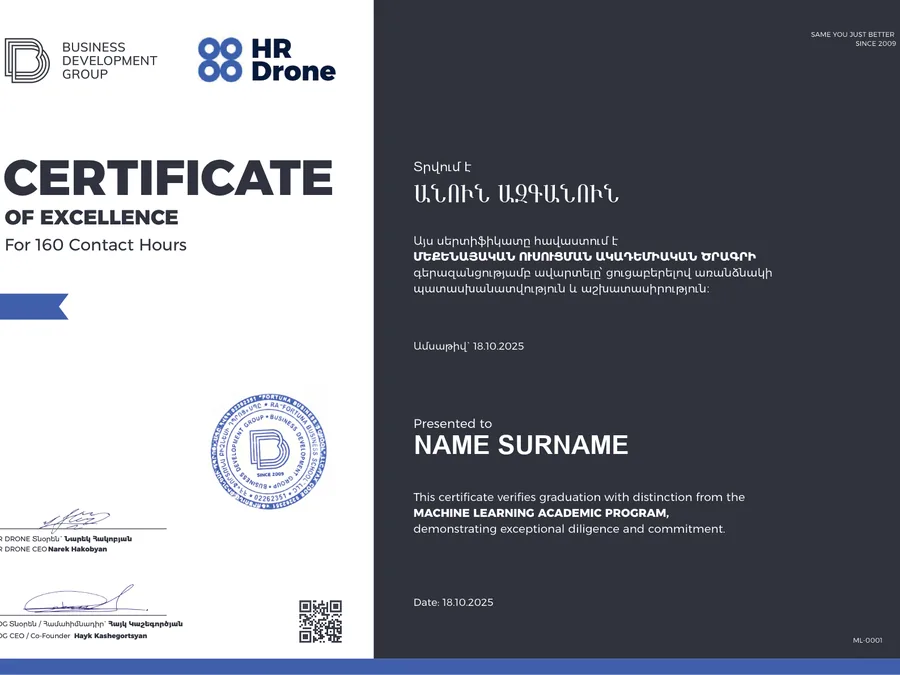 Co-branded
Participation
For students who actively participate in the course learning process.
For active participationCompletion
For students who complete the course requirements and finish the program.
For successful completionExcellence
For students who complete the course with outstanding results and strong performance.
With distinctionHR Drone
A co-branded certificate for selected HR and partner-certified programs.
Co-brandedManagement
Ready to start Agile Project Management Essentials?
Book a free consultation and reserve your place in the next cohort.
65,000 ֏
/ month
2 months · Starts — July 30, 2026
100% booked
Keep exploring
Related courses
New
Management
2 months
•
Offline
Agile Project Management
Starts 17.12.2026
66% booked
Internship opportunity
Management
2 months
•
Offline
Project Management : AI Powered
Starts 19.11.2026
97% booked
Internship opportunity