Career Advice
Get practical guidance on career growth, job search, interviews, CV improvement, and the next steps in your professional path.
Free consultation · Certificate on completion · Practical learning
Duration
5 weeks
Format
Offline
Level
Intermediate
Starts
17.09.2026
Certificate
On completion
Lessons
8 lessons
Price
59,000 ֏ · full course
Schedule
Admission to the course is based on an interview.
At BDG, learning continues beyond lessons. You get access to guidance, community, events, spaces, and resources that support your professional growth.
Get practical guidance on career growth, job search, interviews, CV improvement, and the next steps in your professional path.
Learn how to present your skills, build professional visibility, and create a stronger personal brand in your field.
Join free webinars, seminars, and open sessions every month to keep learning, meet experts, and discover new opportunities.
Become part of a large professional community of students, graduates, trainers, and industry specialists.
Use BDG spaces for learning, networking, teamwork, and focused work when you need the right environment to grow.
Access useful books, materials, guides, and learning resources selected to support your development.
Why Join the “AI Product Engineering: From Concept to Launch” Course?
If you want to go beyond simply using AI tools and understand how to build a real, working product with AI, this course is for you.
The course gives you the opportunity to:
take an idea all the way to a live product,
work with modern AI and development tools,
integrate AI capabilities into your own product,
understand the fundamentals of deployment, security, and cost management,
test your product with real users,
complete the course with a working, portfolio-ready project rather than theoretical knowledge alone.
In other words, you will learn not only what AI can do, but what you can build with it.
Get 5% Cashback
Pay with easywallet QR Code
Business Owners and Entrepreneurs
The course is designed for business leaders and entrepreneurs who want to replace fragmented processes with functional systems and improve their operations using modern AI-powered solutions.
AI Beginners
The course is also suitable for professionals who have already taken their first steps with AI and want to deepen their knowledge, develop practical skills, and gain hands-on experience in the field.
Professionals from Other Fields
Professionals from different industries can join the course if they have a real business idea they want to turn into a working product. They can also apply what they learn to build solutions and improve processes within the companies they work for.
What AI actually is: a statistical prediction model, not a knowledge system — Data → Patterns → Probability
Deterministic software vs. probabilistic AI — “regular software breaks, AI is wrong with confidence”
Alan Turing and the Turing Test, the coining of “artificial intelligence,” ELIZA
How AI was trained, and who trained it: reCAPTCHA as unpaid labelling, annotation labour and “ghost work”
The invisible AI we already use: Siri, Netflix, Spotify, TikTok, Google Translate
The AI effect: why AI stops looking like AI the moment it works
The OpenAI story: Sam Altman, Y Combinator, DeepMind’s acquisition, the founding of OpenAI, Musk’s exit, non-profit → capped-profit → public benefit corporation
“The Blip” — November 2023 and what it revealed about AI governance
The diaspora: Anthropic, SSI, Thinking Machines, xAI
The current model landscape: US frontier labs and Chinese open-weight labs; closed vs. open weights as competing business models
The AI bubble debate
The three assistants, compared not feature lists, but where each one is actually stronger: reasoning style, long documents, code, image and video, search, speed, price
Where each one sits in a build workflow, and why most professionals end up using two rather than one
The three ways AI reaches your data
Plugins / GPTs / Gems capability bolted onto the assistant’s own interface
Connectors a ready-made link to a service someone else already built (Gmail, Drive, Slack)
MCP an open standard that lets any AI client talk to any system, including one you build yourself
Why MCP became the standard and what it changed: an integration written once works in every client that speaks it
Context, memory and projects - what each assistant actually retains, and what it quietly forgets
Cost and limits: what you are paying for, and what runs out
Choosing the stack for this course, and why: Claude Code for building, Figma Make + Claude Design for design, Replit for the first deploy, Supabase for data, Vercel for production
From a paragraph to a design: prompting a design tool for a result you can actually use
Iteration as the real skill: describe → look → refine. Where AI design output still needs a human eye
The intake form — the piece that matters. Fields, validation, what happens after submit
Taking a design out of Figma Make and into a working page in Replit
Responsive behaviour: it has to work on a phone, because that’s where it will be opened
Publishing: the first live URL
Where the form data goes for now — a deliberately temporary answer, replaced in lecture 4. Building something you know you’ll rip out is normal, and saying so removes the fear of it
Spec → plan → build. Give Claude Code the spec, make it produce a plan, correct the plan, then let it build. Most vibe coding disasters are planning failures that happened quickly
Working in a real repository - and Git as an undo button: commits, branches, and how to get back after a confident լbad edit destroys something. Taught here, deliberately early, because this is the failure that ends people’s projects
Supabase: tables, relationships, and what a database is actually doing. The request table, the notes table, the staff table
Authentication - a login screen, real accounts, who is allowed in
The two screens that matter: the queue (all requests, filterable) and the detail view (one request, with notes and status)
Rewiring the landing page form to write into the real database. The two surfaces become one product
Reading a diff you didn’t write: what to check, what to always question
What it means to call AI from inside your own product rather than from a chat window — the same model, a completely different relationship to it. AI writes the integration; participants understand the shape of it
Auto-triage: a new request arrives → the AI assigns a category, sets urgency, writes a two-line summary. The queue becomes sorted by something meaningful
Draft reply: the AI writes a response, a human edits and approves. The approval step is the lesson — the AI never sends anything by itself
Ask across everything: a question box that answers from all the requests in the database. “What are people complaining about most this month?”
Prompts as part of the product — living in the codebase, versioned, editable, not retyped into a chat each time
When it’s wrong in production: fallbacks, sensible defaults, error states, and the rule that a failed AI call must never block the human from working
A 15-case sanity check: run real submissions through the triage, count how many it got right, fix the prompt, count again
Cost per request - measured, not guessed. What this platform costs at 100 requests a month, and at 5,000
MCP: connecting Claude directly to the platform’s own data, so the business can be run from a chat window as well as from the screens
Moving from Replit to Vercel: what a production host gives you, and why the thing you built in class isn’t yet the thing you can hand to a client
Consolidating the two surfaces. Until now the landing page has lived in Replit and the platform in a GitHub repo. Here they move onto one host, one domain — the public page at the root, the platform behind a login. This is the moment the two halves become one deployed product
Custom domain and DNS — buying it, pointing it, HTTPS. Fifteen minutes of genuinely fiddly work, done together
Environment variables and secrets: why an API key must never reach the browser, and how to check that yours hasn’t. Demonstrated live, including what a leaked key looks like on a bill
Supabase Row Level Security — the one that actually matters. Without it, a public application’s database is readable by anyone who looks. Every participant enables and tests it before leaving the room
Who can see what: staff vs. admin, and the one-line mistake that shows every clinic’s requests to every other clinic
Cost caps and rate limits — protecting yourself from a loop, a bot, or a bad month
Logs and monitoring: knowing something broke before the client tells you
Backups, and the uncomfortable question of what happens if you disappear
Putting it in front of three real people and watching them use it without helping. The most uncomfortable and most valuable twenty minutes of the course
The gap between what you thought would break and what broke
Visual polish: fixing hierarchy, spacing, empty states, loading states, error messages — the difference between “a student project” and “a product”
Copy that works: what the buttons say, what an empty queue says, what the user sees when something fails
Speed: why it feels slow, and what to do about it
The iteration loop at production speed: feedback → spec change → Claude Code → review → deploy, several times in one session
Handover documentation — a short README so someone who isn’t you can run it. Written by AI, checked by the participant
What maintaining a live product actually involves once the course ends
Each participant presents the live product, not slides:
Open the public domain — a real URL, in front of everyone
Submit a request from the landing page
Log into the platform, show it arrive, show the AI triage it
Draft and approve a reply
Show one thing that broke during the course and how it was fixed
State the monthly running cost
Secure your place and take the next step in your professional growth.

CEO and Co-Founder at Doctor Yan
Originally trained as an architect, Irina later chose a different career path
Each course is labelled beginner, intermediate or advanced. If you are unsure, book a free consultation and we will help you choose.
Flexible payment options are available for most programs. Contact us to discuss the right plan for you.
We mostly hold trainings with a Project Based Learning approach. Thanks to this approach, the students gain practical knowledge and develop their proficiency in the most efficient way.
After each training the students pass exams. Thus, both students and trainers have the opportunity to clearly assess the effectiveness of the training. Based on the results of the exams the students get certificates.
Upon completion of the training we give certificates to our students. Moreover, those whose performance is above 80% receive certificates of excellence.
We have developed a partner network that includes current best employers. In cooperation with them we do our best to assist our students in finding jobs. This network also helps us to organise internships for our students after the trainings.
Payment for the courses is made after the first lesson until the second lesson, in cash or by transfer. Payment for each stage is made for a fixed amount of 8 lessons.
Our courses are held in 2 main formats: online and offline. We believe that maintaining the format is very important for the effectiveness of the course.
BDG classrooms are technically equipped, and if necessary, we also provide students with laptops.
There is a break during each course, during which you can have a coffee and tea break.
HR consulting is carried out with our Career Development Specialist. With him, you can discuss your CVs, make corrections and finalize them, ready to apply for jobs.
All course materials, including recordings, books provided by trainers and other educational materials, are constantly available to our students during the course.
Individual courses are not currently designed, based on market needs and demands. During group courses, participants are also actively involved in teamwork, develop their communication skills, and learn to work in a team.
There is no age limit as such, as we value the spread of education to all age groups. It is especially important for us that people who already have experience and knowledge and want to acquire a new profession also go into a new educational direction.
Admission to each course is carried out through an interview or a test, or both at the same time. The choice of admission method depends on the requirements and specifics of the course.
We provide technical support to all our students related to the operational work of computers, as well as technical issues. The support is provided by our employee within the framework of the course.
Our team is in constant contact with students to provide the information you need, if necessary.
Certificates
Depending on the course format and results, students can receive one of BDG's certificate types.
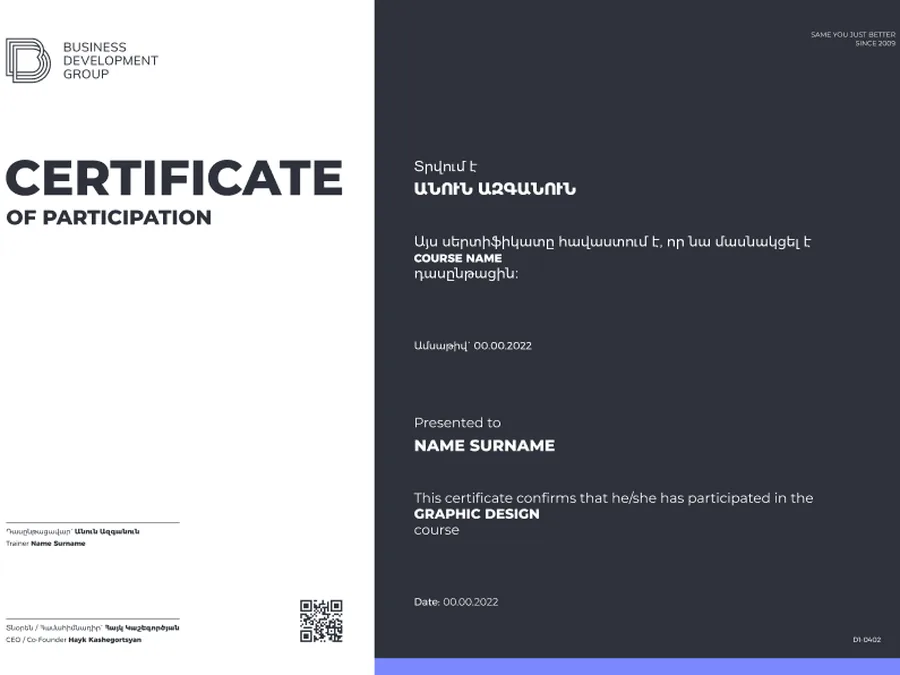
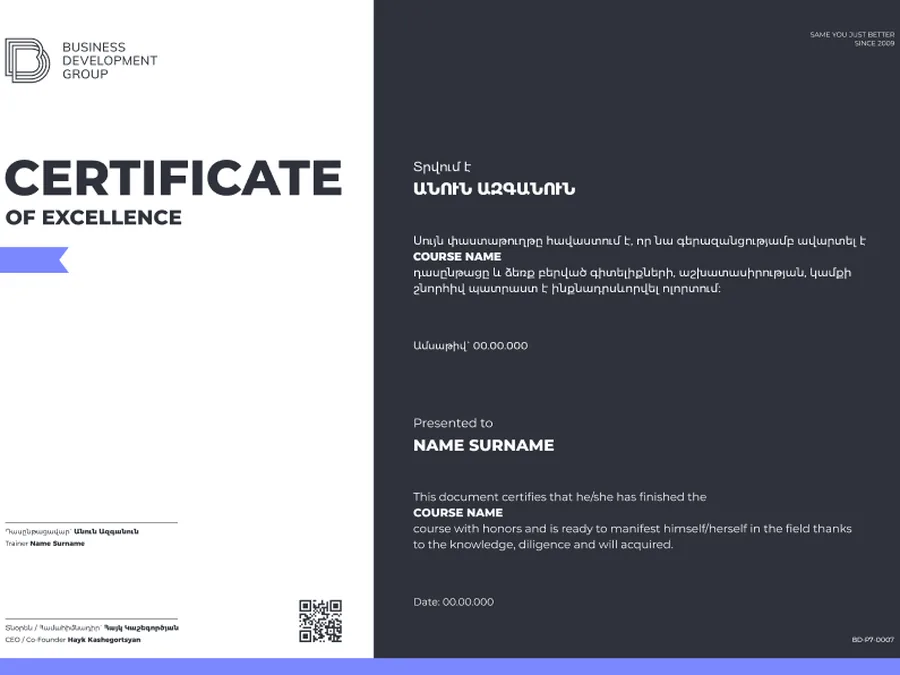
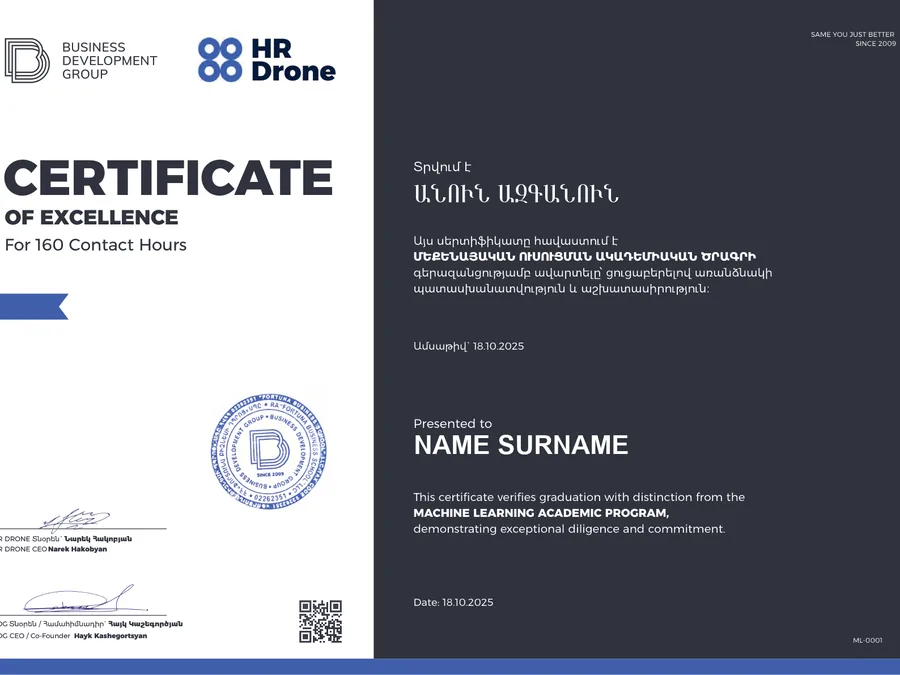 Co-branded
For students who actively participate in the course learning process.
For active participationFor students who complete the course requirements and finish the program.
For successful completionFor students who complete the course with outstanding results and strong performance.
With distinctionA co-branded certificate for selected HR and partner-certified programs.
Co-brandedAI Octopus
Book a free consultation and reserve your place in the next cohort.
5 weeks · Starts — September 17, 2026
89% booked