AI Octopus
·Offline New
Vibe Coding and Agentic Development
- ✓ Effective use of AI tools and coding agents
- ✓ Strong prompting and context-design skills
- ✓ The ability to build software from specifications
- ✓ Skills for reviewing and improving AI-generated outputs
Free consultation · Certificate on completion · Practical learning
Duration
2 months
Format
Offline
Starts
08.07.2026
Certificate
On completion
Payment
monthly
Lessons
14 lessons
Price
57,000 ֏
Program
- What Large Language Models and coding agents really are: their capabilities and limitations
- Hallucinations, context limitations, and the risks of overreliance on automation
- The AI tooling ecosystem: from chat interfaces to coding agents embedded in development environments
- Practical exercise
- Homework assignment
- Why the instruction “make it better” does not work
- The importance of specificity, constraints, examples, and iterative refinement
- Context as the foundation of outcomes: what an agent knows and what you need to tell it
- Solving the same problem across ChatGPT, Builder, Cursor, and Claude Code
- Why results differ
- Homework assignment
- From vibe coding to an engineering mindset
- From requirements to plans, tasks, and code
- Intent as the source of truth
- The Explore → Plan → Build workflow
- Project memory files
- Writing effective specifications: acceptance criteria, definition of done, scope boundaries, explicit constraints
- Practical exercise
- Homework assignment
- Quality review as a mandatory stage
- What quality means at the specification level
- Completeness, testability, ambiguity detection, and prevention of scope creep
- Specification quality checklist
- Defining acceptance criteria, edge cases, and completion criteria before generating code
- Reviewing AI-generated plans and task lists
- Identifying missing dependencies, faulty assumptions, and hallucinated steps
- Collaborative specification review practices
- Critiquing specifications with AI assistance
- Individual assignment
- Homework assignment
- Why rollback ability becomes critical when agents can generate hundreds of lines of code within minutes
- Git fundamentals for beginners
- Understanding commits, branches, and reverts
- Core GitHub workflows
- How to understand what an agent has changed
- Comparing and analyzing changes
- Requiring AI to explain its modifications before accepting them
- Homework assignment
- Working with databases without complexity
- Supabase fundamentals
- What authentication is and why you should not build it from scratch
- Connecting agents to external systems
- MCP servers, APIs, environment variables, and secrets
- Secure management of sensitive information
- Practical exercise
- Homework assignment
- Quality verification as a mandatory control gate
- Effective debugging approaches
- Explain first, fix second
- Tests as a safety mechanism
- Mandatory quality review checkpoints
- Code review for non-developers
- What to verify even without reading every line of code
- Evaluating agent outputs against the original intent
- Practical exercise
- Homework assignment
- Why AI-generated code requires stricter scrutiny
- Key OWASP security risks
- Secret leakage
- Use of incorrect or non-existent libraries
- Security checklists
- Dependency verification
- Input validation
- Data protection mechanisms
- Deploying the capstone project
- Vercel and other hosting platforms
- Domains and monitoring fundamentals
- Homework assignment
- System-level quality assurance
- How agent quality differs from traditional software quality
- Non-deterministic behavior
- Multi-step reasoning failures
- The compounding effect of hallucinations
- Agent evaluation methodologies
- Comparative testing approaches
- Input and output contract validation
- Quality gates within CI/CD workflows
- When to block, warn, or require human intervention
- Analyzing execution traces
- Building a lightweight evaluation framework
- Practical exercise
- Homework assignment
- Moving from single-agent to multi-agent systems
- Sub-agents, command-based workflows, parallel execution, and background tasks
- Workflow automation
- When to delegate and when to maintain control
- Practical exercise
- Homework assignment
- End-to-end quality audit
- Comprehensive capstone review
- Specification completeness
- Test coverage
- Security validation
- Agent evaluation results
- Code review approval
- Collaborative quality reviews
- Remediation and issue resolution
- Creating a quality summary document
- Documenting known risks
- Homework assignment
- Capstone project presentations
- Structured peer reviews
- Applying agent-based development within teams
- When AI should not be used
- Model selection and cost management
- Post-course learning pathways
- Final deliverables: a deployed application, a validated specification, a Git repository, and a quality report
- From interactive workflows to autonomous systems
- Advanced Claude CLI capabilities
- Interactive versus autonomous operating modes
- Using Claude in scripts and CI pipelines
- Autonomous execution modes
- Defining when human approval is required
- Execution control policies
- Hook systems
- Automated quality-control mechanisms
- Creating and reusing slash commands
- Using CLAUDE.md as living project documentation
- Practical exercise
- Homework assignment
- Final capstone presentations
- Quality report presentations
- Peer-based professional evaluations
- Applying agent-based development in real-world projects
- Team collaboration practices
- The limits of responsible and effective AI adoption
- Continuous professional development pathways
- Certificate issuance and portfolio development
Why Join the Course?
This course is designed for professionals who want to go beyond simply using AI tools and learn how to build real software solutions with them.
Throughout the course, students will learn how to work with AI coding agents, write effective prompts, create high-quality specifications, evaluate AI-generated outputs, and build secure, production-ready applications.
By the end of the course, students will have a completed project, a GitHub portfolio, hands-on experience with AI-assisted development, and practical skills that are already in high demand across the technology industry.
Schedule: Wednesdays 19:00–21:30 and Saturdays 14:30–17:00. Offline format. Start date: 08.07.2026.
Get 5% Cashback
Pay with  QR Code
- 1 Pay the tuition by bank transfer in your own name.
- 2 Receive the electronic settlement document confirming the payment.
- 3 File your annual income declaration and include the tuition expense.
- 4 Once approved, the amount is refunded to your bank account.
Who is this course for
-
✓
For Software Developers
Learn how to work with AI coding agents as productivity multipliers rather than simple assistants. You will discover how to accelerate development, review AI-generated code effectively, and build more efficient engineering workflows.
-
✓
For Product Managers and Product Professionals
If you work with requirements, problem definition, and product development, this course will help you move from ideas to working solutions faster. You will learn how to create clear specifications, validate ideas, and collaborate more effectively with technical teams using AI.
-
✓
For Beginners from Any Industry
If you have no programming background but want to build your own digital solutions, this course will help you understand the fundamentals of AI-assisted development. You will learn how to create real projects with AI support without spending years acquiring deep technical expertise.
What you will learn
- ✓Effective use of AI tools and coding agents
- ✓Strong prompting and context-design skills
- ✓The ability to build software from specifications
- ✓Skills for reviewing and improving AI-generated outputs
- ✓Experience in building secure applications and integrations
- ✓Workflow automation through AI agents
Ready to join this course?
Secure your place and take the next step in your professional growth.
Frequently asked questions
Each course is labelled beginner, intermediate or advanced. If you are unsure, book a free consultation and we will help you choose.
Flexible payment options are available for most programs. Contact us to discuss the right plan for you.
We mostly hold trainings with a Project Based Learning approach. Thanks to this approach, the students gain practical knowledge and develop their proficiency in the most efficient way.
After each training the students pass exams. Thus, both students and trainers have the opportunity to clearly assess the effectiveness of the training. Based on the results of the exams the students get certificates.
Upon completion of the training we give certificates to our students. Moreover, those whose performance is above 80% receive certificates of excellence.
We have developed a partner network that includes current best employers. In cooperation with them we do our best to assist our students in finding jobs. This network also helps us to organise internships for our students after the trainings.
Payment for the courses is made after the first lesson until the second lesson, in cash or by transfer. Payment for each stage is made for a fixed amount of 8 lessons.
Our courses are held in 2 main formats: online and offline. We believe that maintaining the format is very important for the effectiveness of the course.
BDG classrooms are technically equipped, and if necessary, we also provide students with laptops.
There is a break during each course, during which you can have a coffee and tea break.
HR consulting is carried out with our Career Development Specialist. With him, you can discuss your CVs, make corrections and finalize them, ready to apply for jobs.
All course materials, including recordings, books provided by trainers and other educational materials, are constantly available to our students during the course.
Individual courses are not currently designed, based on market needs and demands. During group courses, participants are also actively involved in teamwork, develop their communication skills, and learn to work in a team.
There is no age limit as such, as we value the spread of education to all age groups. It is especially important for us that people who already have experience and knowledge and want to acquire a new profession also go into a new educational direction.
Admission to each course is carried out through an interview or a test, or both at the same time. The choice of admission method depends on the requirements and specifics of the course.
We provide technical support to all our students related to the operational work of computers, as well as technical issues. The support is provided by our employee within the framework of the course.
Our team is in constant contact with students to provide the information you need, if necessary.
Certificates
Certificates you can receive
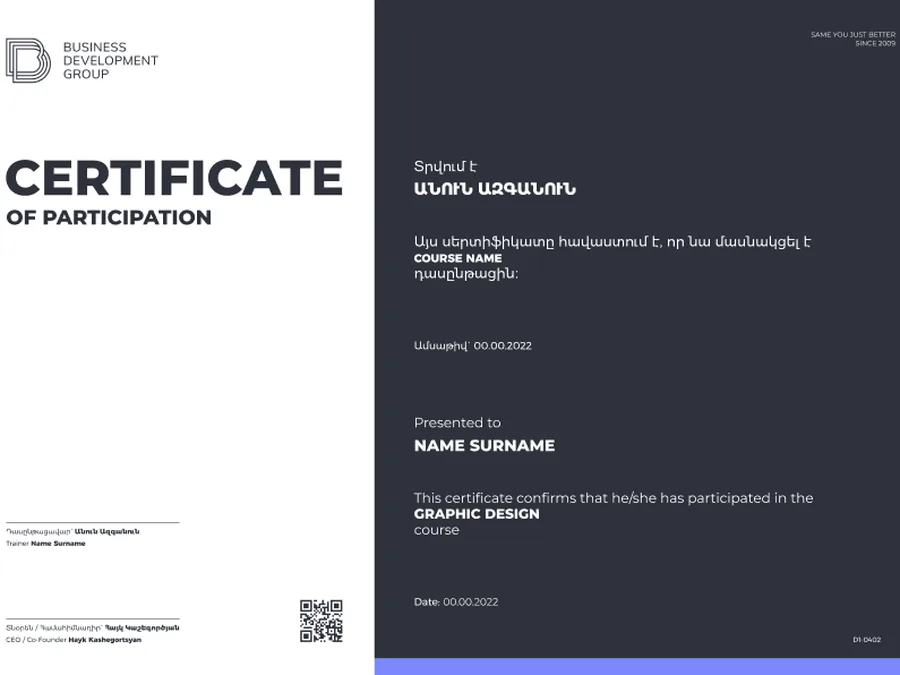
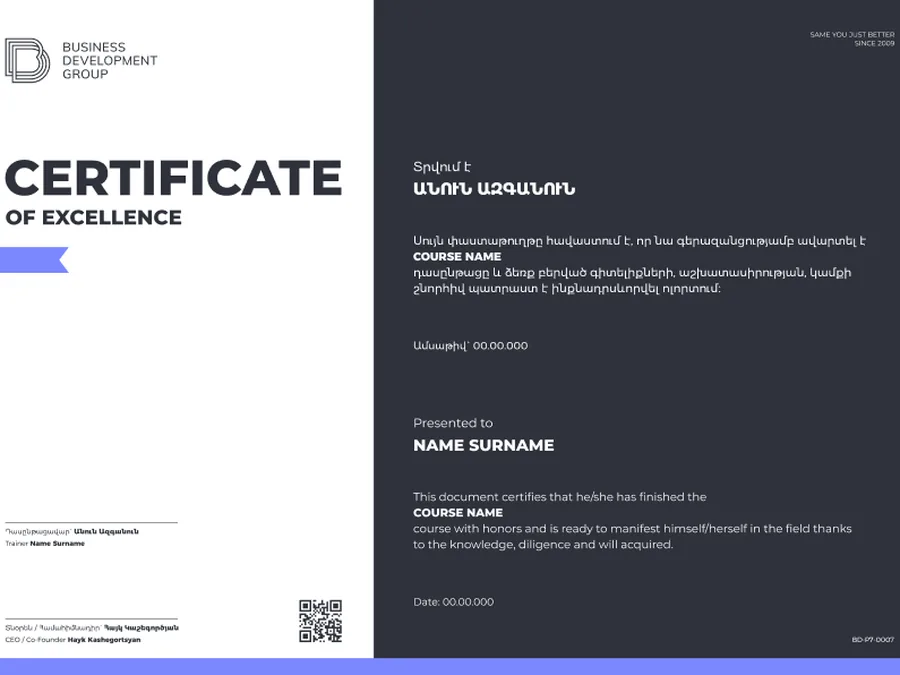
Depending on the course format and results, students can receive one of BDG's certificate types.
- ✓ Verified BDG certificate
- ✓ QR / signature-ready format
- ✓ Armenian & English certificate design
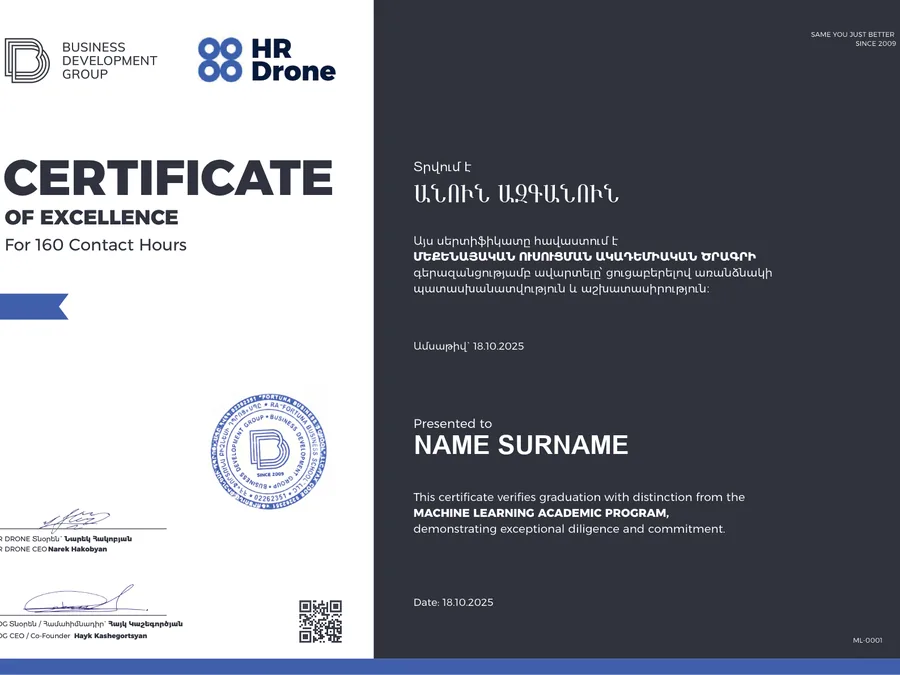 Co-branded
Participation
For students who actively participate in the course learning process.
For active participationCompletion
For students who complete the course requirements and finish the program.
For successful completionExcellence
For students who complete the course with outstanding results and strong performance.
With distinctionHR Drone
A co-branded certificate for selected HR and partner-certified programs.
Co-brandedAI Octopus
Ready to start Vibe Coding and Agentic Development?
Book a free consultation and reserve your place in the next cohort.
57,000 ֏
2 months · Starts — July 08, 2026
47% booked
Keep exploring
Related courses