
IT and Programming
·Offline New
Cybersecurity Full Course
- ✓ Security fundamentals
- ✓ Basic network security
- ✓ System and endpoint security
- ✓ Operating system administration
Free consultation · Certificate on completion · Practical learning
Duration
5 months
Format
Offline
Level
Intermediate
Starts
25.03.2026
Certificate
On completion
Payment
Monthly
Price
69,000 ֏
Internship opportunity
Top-performing students may receive an internship opportunity.
Program
- Concepts: Distinguishing between Information Security and Cybersecurity.
- Security Architecture: Strategic overview of Defensive Technologies.
- Advanced Analytics: Different Types of Threat Sources in the Environment.
- The Foundation: The CIA Triad and its application in modern risk landscapes.
- Career Pathing: Specialization in Offensive, and Defensive operations.
- Malware Classifications: Differences between Viruses, Worms, Trojans, Spywares, and Ransomwares.
- Service Disruptions: DoS and DDoS attack vectors and mitigation strategies.
- Emerging Risks: Zero-day vulnerabilities and Supply Chain compromises.
- Persistent Threats: Advanced Persistent Threats (APT) and Insider Threat profiling.
- AI Security (AISec): Privacy violations, algorithmic bias, and adversarial machine learning risks.
- Social Engineering: Cognitive manipulation and Phishing methodologies.
- The Cyber Kill Chain: Analyzing the phases.
- MITRE ATT&CK®: Mapping Adversary Tactics, Techniques, and Common Knowledge.
- Tactical Analysis: Understanding the "How" and "Why" of adversary behavior.
- The AAA Framework: Authentication, Authorization, and Accounting.
- Access Control Models: RBAC, PBAC/ABAC, MAC, SSO, and Multi-Factor Authentication (MFA).
- Credential Management: Modern password security standards.
- Data Loss Prevention (DLP): Fundamentals of data discovery, monitoring, and exfiltration prevention
- Hypervisor Technology: Virtualization architecture.
- Container Security: Introduction to Docker and microservices isolation.
- Applied Environment: Kali Linux deployment and CLI proficiency.
- Permission Models: Access Controls and Linux file system security.
- System Hardening: Managing services, sudoers configuration, and privilege models.
- Audit & Logging: Analyzing Linux authentication logs and system telemetry.
- Escalation Taxonomy: Horizontal vs. Vertical movement.
- Exploitation Vectors: Misconfigured SUID/GUID binaries, Cron job exploitation, and PATH hijacking.
- File System Exploits: Insecure permissions and sensitive data discovery.
- The Windows Registry: Configuration management and persistence mechanisms.
- Process Analysis: Utilizing Task Manager and Process Explorer for forensic visibility.
- Execution Models: Distinguishing between User-mode and Kernel-mode processes.
- Vector Analysis: Unquoted service paths, insecure service permissions, and DLL hijacking.
- Credential Harvesting: Stored credentials, SAM database, and scheduled task exploitation.
- Defense Evolution: Comparative analysis of Signature-based AV vs. EDR/XDR.
- Heuristic Detection: Identifying anomalous behavior and post-exploitation activity.
- AD Infrastructure: Domain Controllers, Forests, Trees, and Organizational Units (OUs).
- Authentication Protocols: Differences between Kerberos and NTLM.
- Attack Vectors: Common AD misconfigurations (AS-REP Roasting, Kerberoasting).
- Email Infrastructure: Secure messaging protocols and the psychology of Phishing.
- Authentication Standards: Implementation of SPF, DKIM, and DMARC.
- Defense-in-Depth: Implementing layered security controls (Administrative, Technical, Physical).
- Control Taxonomy: Preventive, Detective, and Corrective controls.
- Zero Trust Architecture (ZTA): Moving from perimeter defense to "Never Trust, Always Verify."
- Reconnaissance: Identifying exposed ports, services, and vulnerabilities.
- Vulnerability Mapping: Assessing the risk of legacy protocols and open services.
- MITM Architectures: ARP Spoofing, DNS Poisoning, and Session Hijacking.
- Protocol Weaknesses: Exploitability of unencrypted network traffic.
- Perimeter Defense: Next-Gen Firewalls (NGFW), DDOS protection, and other perimeter security solutions.
- Intrusion Management: IDS vs. IPS deployment strategies.
- Segmentation: Network isolation, VLANs, and Micro-segmentation.
- Protocol Analysis: Deep Packet Inspection (DPI) using Wireshark.
- Traffic Forensics: Identifying malicious patterns within PCAP data.
- Wireless Protocols: WPA2/WPA3 security models and vulnerabilities.
- RF Threats: Rogue Access Points, Evil Twins, and de-authentication attacks
- Foundations: Symmetric vs. Asymmetric encryption.
- Data Integrity: Hashing algorithms and Digital Signatures.
- PKI & Web Security: SSL/TLS handshake and HTTPS implementation.
- Attack Methodologies: Brute force, Dictionary, and Known-Plaintext attacks.
- Enterprise Encryption: Full Disk Encryption and Secrets Management.
- Standards: OWASP, CVSS (Scoring), and CVE (Naming) conventions.
- Pentest Lifecycle: Exploration of pentest’s lifecycle.
- Governance: Rules of Engagement (RoE) and Legal Compliance.
- HTTP/S Lifecycle: Request/Response anatomy, headers, and session management.
- The Trust Model: Distinguishing between Client-side and Server-side security.
- In-depth Analysis: Union-based, Error-based, and Blind SQL Injections.
- Impact Assessment: Bypassing authentication and database exfiltration.
- Execution Models: Reflected, Stored, and DOM-based XSS.
- Mitigation: Input sanitization and context-aware output encoding.
- Remediation: Implementation of secure coding practices and input validation.
- Offensive Simulation: Utilizing reverse shells and the Metasploit Framework.
- Exploitation: Session Fixation, Hijacking, and Privilege Escalation.
- Exploitation: Bypassing MIME-type validation and Remote Code Execution (RCE) usage.
- Modern Interfaces: API security, Token-based authentication (JWT), and BOLA (Broken Object Level Authorization).
● Documentation: Technical writing for vulnerability findings and executive remediation summaries.
- Architectures: Data ingestion, Log normalization, and Correlation Rules.
- Monitoring: Continuous visibility and SOC use-case development.
- Rule Development: Signatures vs. Behavioral Indicators (IoC vs. IoB).
- Optimization: Tuning alerts and managing False Positives.
● General frameworks Framework: Explanation of IR lifecycle.
● Strategic Intelligence: TTP (Tactics, Techniques, Procedures) profiling and Adversary tracking.
- Evidence Handling: Chain of Custody and Data Integrity.
- Artifact Analysis: Disk, Memory, and Log forensics.
- Methodology: Hypothesis-driven hunting vs. IoC-based searching
- Shared Responsibility Model: Securing IaaS, PaaS, and SaaS environments.
- Cloud IAM: Managing identities in different types of platforms.
Post-Exploitation: C2 frameworks, Pivoting, and Remote Control techniques
- Full-scale Penetration Test concluding with a Professional Pentest Report.
● Full-scale Detection and Response CTF
- Theoretical and Practical certification assessment
Why Join the Course?
Why Join the “Cybersecurity Full Course”?
If you want to gain in-demand knowledge aligned with international standards in the field of cybersecurity, this program is designed for you. During the course, you will learn:- The fundamental security principles of Windows, Linux, and Web systems
- Vulnerability identification and assessment
- Core security concepts of Active Directory and Cloud environments
- Key mechanisms and practical approaches to penetration testing
- Infrastructure log analysis and Root Cause Analysis
Get 5% Cashback
Pay with  QR Code
- 1 Pay the tuition by bank transfer in your own name.
- 2 Receive the electronic settlement document confirming the payment.
- 3 File your annual income declaration and include the tuition expense.
- 4 Once approved, the amount is refunded to your bank account.
Who is this course for
-
✓
Professionals Entering the Cybersecurity Field
The course is suitable for individuals who are interested in technology, have a foundational understanding of IT, and want to enter the cybersecurity field. Analytical thinking, the ability to make risk-based decisions, stress resilience, and a problem-solving mindset are essential qualities for success in this area.
-
✓
Entry-Level IT Professionals
IT professionals with knowledge of operating systems and networking who are considering cybersecurity as a future career path are also encouraged to join.
What you will learn
- ✓Security fundamentals
- ✓Basic network security
- ✓System and endpoint security
- ✓Operating system administration
- ✓Vulnerability management and penetration testing
- ✓Basic cryptography
Ready to join this course?
Secure your place and take the next step in your professional growth.
Trainer

Narek Papyan
Head of Cybersecurity Department
Narek’s key professional achievement lies not only in his technical successes but also in building a strong and thoughtful team. As a mentor, he emphasizes daily challenges and the...
Frequently asked questions
Each course is labelled beginner, intermediate or advanced. If you are unsure, book a free consultation and we will help you choose.
Flexible payment options are available for most programs. Contact us to discuss the right plan for you.
We mostly hold trainings with a Project Based Learning approach. Thanks to this approach, the students gain practical knowledge and develop their proficiency in the most efficient way.
After each training the students pass exams. Thus, both students and trainers have the opportunity to clearly assess the effectiveness of the training. Based on the results of the exams the students get certificates.
Upon completion of the training we give certificates to our students. Moreover, those whose performance is above 80% receive certificates of excellence.
We have developed a partner network that includes current best employers. In cooperation with them we do our best to assist our students in finding jobs. This network also helps us to organise internships for our students after the trainings.
Payment for the courses is made after the first lesson until the second lesson, in cash or by transfer. Payment for each stage is made for a fixed amount of 8 lessons.
Our courses are held in 2 main formats: online and offline. We believe that maintaining the format is very important for the effectiveness of the course.
BDG classrooms are technically equipped, and if necessary, we also provide students with laptops.
There is a break during each course, during which you can have a coffee and tea break.
HR consulting is carried out with our Career Development Specialist. With him, you can discuss your CVs, make corrections and finalize them, ready to apply for jobs.
All course materials, including recordings, books provided by trainers and other educational materials, are constantly available to our students during the course.
Individual courses are not currently designed, based on market needs and demands. During group courses, participants are also actively involved in teamwork, develop their communication skills, and learn to work in a team.
There is no age limit as such, as we value the spread of education to all age groups. It is especially important for us that people who already have experience and knowledge and want to acquire a new profession also go into a new educational direction.
Admission to each course is carried out through an interview or a test, or both at the same time. The choice of admission method depends on the requirements and specifics of the course.
We provide technical support to all our students related to the operational work of computers, as well as technical issues. The support is provided by our employee within the framework of the course.
Our team is in constant contact with students to provide the information you need, if necessary.
Certificates
Certificates you can receive
Depending on the course format and results, students can receive one of BDG's certificate types.
- ✓ Verified BDG certificate
- ✓ QR / signature-ready format
- ✓ Armenian & English certificate design
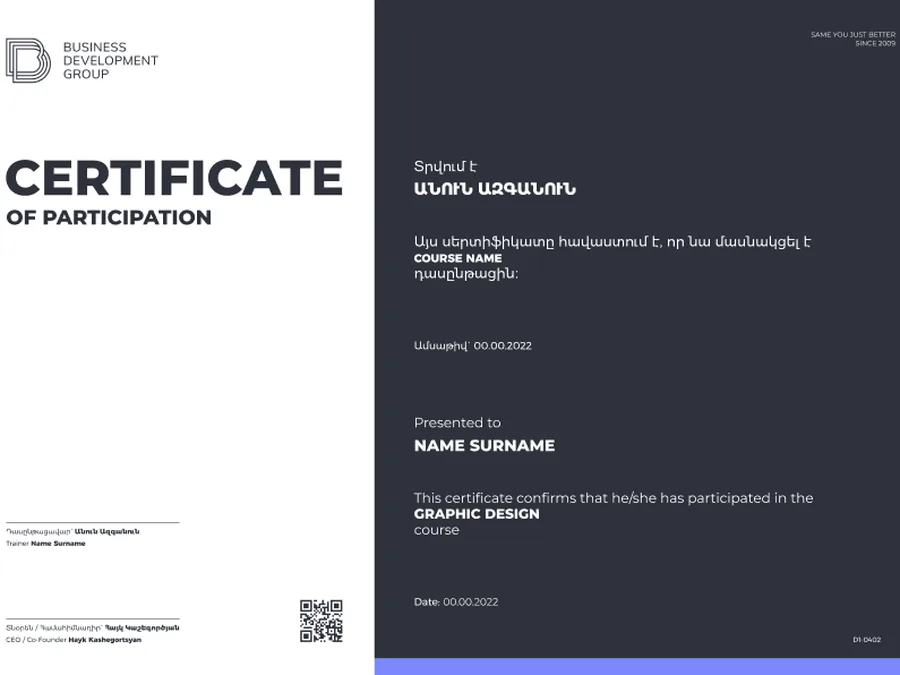
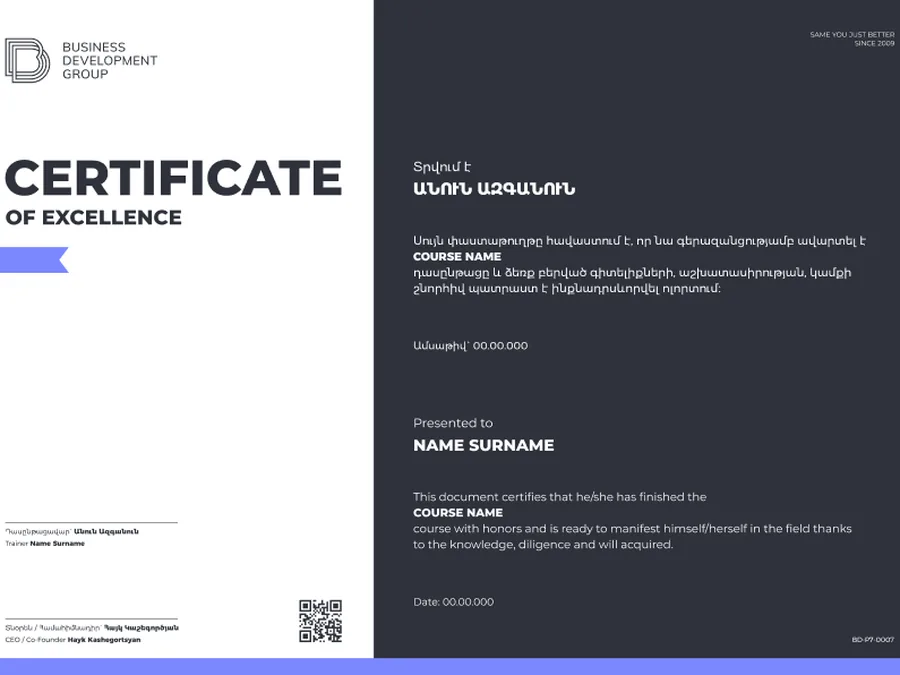
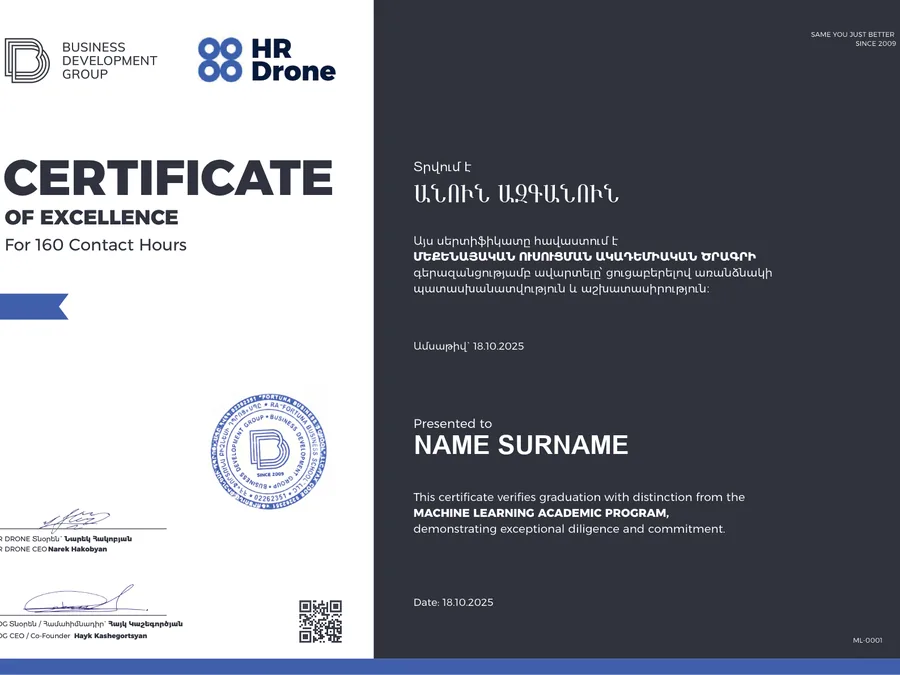 Co-branded
Participation
For students who actively participate in the course learning process.
For active participationCompletion
For students who complete the course requirements and finish the program.
For successful completionExcellence
For students who complete the course with outstanding results and strong performance.
With distinctionHR Drone
A co-branded certificate for selected HR and partner-certified programs.
Co-brandedIT and Programming
Ready to start Cybersecurity Full Course?
Book a free consultation and reserve your place in the next cohort.
69,000 ֏
5 months · Starts — March 25, 2026
Internship opportunityKeep exploring
Related courses
IT and Programming
4 hours
•
Offline
AI for Engineering: Build, Debug & Automate Workshop
Starts 28.11.2026
79% booked