IT and Programming
·Offline
Python Full Course: AI Powered
- ✓ Writing Python Code
- ✓ Creating Automated Tests
- ✓ Completing an End-to-End Project on GitHub
- ✓ Practical Experience Required for an Entry-Level Python Developer
Free consultation · Certificate on completion · Practical learning
Duration
5 months
Format
Offline
Level
Beginner
Starts
21.10.2026
Certificate
On completion
Lessons
42 lessons
Price
63,000 ֏ / month
Schedule
- Wednesday · 19:30–22:00
- Saturday · 11:00–13:30
Program
- • What is Python & why learn it?
- • Python Installation
- • VS Code/PyCharm Setup
- • First Script
- • Understanding AI
- • First Encounter with LLMs
- • Practice & Homework
- • Review + Q&A
- • Git Installation & Identity
- • Git Fundamentals
- • Essential Git Commands
- • GitHub & Authentication
- • Project Documentation
- • Homework Organization
- • Submission Workflow
- • Practice
- • Review + Q&A
- • Variables
- • Data Types
- • Type Conversion & type()
- • User Input
- • Arithmetic Operators
- • Assignment Operators
- • Expressions
- • Operator Precedence
- • Practice
- • Review + Q&A
- • Comparison Operators
- • if / elif / else
- • Boolean Logic
- • Nested Conditions
- • Rules & AI Comparison
- • Practice
- • Review + Q&A
- • for Loop
- • while Loop
- • break / continue
- • Choosing a Loop
- • Practice
- • Review + Q&A
- • Nested Loops
- • Loop Patterns & Idioms
- • Input & Menu Loops
- • Problem-Solving Practice
- • Practice
- • Review + Q&A
- • Lists
- • List Methods
- • List Comprehensions
- • Tuples
- • Practice
- • Review + Q&A
- • Sets
- • Dictionaries
- • Dictionary Methods
- • Choosing Data Structures
- • Practice
- • Review + Q&A
- • Nested Structures
- • Accessing Nested Data
- • Iterating Data Structures
- • Data Transformation
- • Practice
- • Review + Q&A
- • Function Basics
- • Why Functions Matter
- • Function Design
- • Return Values
- • Practice
- • Review + Q&A
- • Arguments Deep Dive
- • Scope
- • Functions as Objects
- • Practice
- • Review + Q&A
- • Modules & Imports
- • Packages
- • Standard Library
- • Git Workflow Practice
- • Practice
- • Review + Q&A
- • Virtual Environments
- • Creating Environments
- • pip & Dependencies
- • Dependency Files
- • Project Structure
- • Practice
- • Review + Q&A
- • Common Errors
- • Reading Tracebacks
- • Exception Handling
- • Raising Exceptions
- • Debugging Techniques
- • Practice
- • Review + Q&A
- • Why Testing Matters
- • Test Design
- • Fixtures
- • Practice
- • Review + Q&A
- • String Methods
- • String Indexing & Slicing
- • String Formatting
- • Text Processing Patterns
- • Why Regular Expressions?
- • re Module
- • Basic Patterns
- • Groups & Extraction
- • Validation
- • Practice
- • Continued Text Practice
- • Review + Q&A
- • AI Coding Assistants
- • Debugging with AI
- • Code Review & Refactoring
- • Clear Development Prompts
- • Testing Suggested Changes
- • Practice
- • Review + Q&A
- • What is OOP & Why?
- • Classes & Objects
- • Methods
- • Practice
- • Review + Q&A
- • Inheritance
- • Method Overriding
- • Polymorphism
- • OOP Design Practice
- • Practice
- • Review + Q&A
- • Composition
- • Association Between Classes
- • Encapsulation
- • Properties
- • Class Methods & Static Methods
- • Inheritance vs. Composition
- • Practice
- • Review + Q&A
- • Project Brief
- • Project Planning
- • Architecture
- • Build Time
- • Testing & Error Handling
- • Project Review & GitHub Delivery
- • Branches & Collaboration
- • Practice
- • Review + Q&A
- • Reading & Writing Files
- • Context Managers
- • File System Operations
- • File Management
- • Automation
- • Practice
- • Review + Q&A
- • CSV Fundamentals
- • Reading CSV Files
- • Dictionary-Based CSV Processing
- • Writing & Transforming Data
- • Validation & Cleaning
- • JSON Fundamentals
- • Python JSON Module
- • Nested JSON
- • JSON as a Data Store
- • Practice
- • Review + Q&A
- • Database Concepts
- • SQLite in Python
- • CRUD Operations
- • Queries
- • Parameterized Queries
- • Relational Practice
- • Practice
- • Review + Q&A
- • What is an API?
- • HTTP Request/Response
- • HTTP Methods
- • Request Components
- • HTTP Status Codes
- • Requests Library
- • Response Handling
- • Parameters & Request Bodies
- • Authentication
- • Environment Variables
- • Error Handling
- • Request Timeouts
- • Practice
- • Review + Q&A
- • Combining Data Sources
- • Data Cleaning
- • Introduction to pandas
- • Data Transformation
- • Python vs. pandas
- • Practice
- • Review + Q&A
- • CLI Design Patterns
- • Input Validation
- • Professional Output
- • Packaging a Tool
- • Practice
- • Review + Q&A
- • Project Brief
- • Project Planning
- • Data Collection
- • Data Processing
- • Storage & Querying
- • Build Time
- • Progress Check
- • Final Project Brief
- • Review + Q&A
- • Mini Project #2 Review
- • Automation Concepts
- • Automation Scripts
- • Scheduling
- • Operating System Scheduling
- • Choosing a Scheduling Method
- • Practice
- • Reliable Reruns
- • Review + Q&A
- • Email Automation
- • HTML Emails & Attachments
- • Authentication
- • Report Generation
- • Automated Delivery
- • Practice
- • Review + Q&A
- • FastAPI Setup
- • REST API Endpoints
- • Parameters
- • Responses
- • Automatic Documentation
- • Practice
- • Review + Q&A
- • Pydantic Models
- • Response Models
- • Error Handling
- • Database Integration
- • Application Structure
- • API Testing
- • Type Hints
- • Practice
- • Review + Q&A
- • Project Brief
- • Project Options
- • Architecture Planning
- • Implementation
- • Validation & Error Handling
- • Testing
- • Progress Check
- • Final Project Scope Check
- • Review + Q&A
- • What Are LLMs?
- • Prompt Engineering
- • Prompt Patterns
- • Structured Outputs
- • Prompt Evaluation
- • Practice
- • Review + Q&A
- • AI API Setup
- • Sending Prompts & Handling Responses
- • Error Handling
- • Structured Outputs
- • Integrating AI into Applications
- • Practice
- • Review + Q&A
- • Evaluation Dataset
- • Baselines & Prompt Comparison
- • Schema vs. Answer Quality
- • Failures & Fallbacks
- • Untrusted Inputs
- • Secrets & Operational Limits
- • Practice
- • Review + Q&A
- • AI for Data & Text Processing
- • AI Pipelines
- • Traceable Results
- • Practice
- • Review + Q&A
- • Project Brief
- • Project Options
- • Architecture Planning
- • Implementation
- • Error Handling & Validation
- • Testing & Documentation
- • Progress Check
- • Practice
- • Review + Q&A
- • Project Ideation
- • Architecture & MVP Planning
- • Development
- • Practice
- • Review + Q&A
- • Integration
- • Code Quality
- • Code Review & Collaboration
- • Practice
- • Review + Q&A
- • Testing & Edge Cases
- • Hardening
- • Finalization
- • Practice
- • Review + Q&A
- • Final Project Presentations
- • Project Review & Feedback
- • GitHub Portfolio Polish
- • CV & LinkedIn
- • Interview Basics
- • Career Paths
- • Learning Roadmap
- • Course Wrap-up
Why Join the Course?
Python is widely used across three key areas today: data analysis, test automation, and backend development and AI integration. At the same time, AI tools are rapidly transforming how people work, and employers are increasingly seeking professionals who can apply them in practice.
By the end of the course, participants will be able to independently plan and build Python applications using databases, APIs, and AI tools. They will be able to process and analyze data from real-world sources, write automated tests, and debug their own code. They will also learn to plan and manage a software project from the initial idea through to publication on GitHub. As a result, students will also be able to integrate AI models into their projects.
Get 5% Cashback
Pay with  QR Code
- 1 Pay the tuition by bank transfer in your own name.
- 2 Receive the electronic settlement document confirming the payment.
- 3 File your annual income declaration and include the tuition expense.
- 4 Once approved, the amount is refunded to your bank account.
Who is this course for
-
✓
Career Changers
For those who want to enter the programming field, learn Python from scratch, and develop the practical skills needed to start a new career.
-
✓
IT Professionals
For QA specialists, data analysts, and other IT professionals who want to automate workflows with Python, work with APIs and databases, and expand their technical skill set.
-
✓
Managers
For team and project managers who want to better understand the potential of programming, automation, and AI solutions, collaborate more effectively with technical teams, and improve workflows.
-
✓
Students
For students and early-career professionals who want to build a strong foundation in Python, complete practical projects, and develop a GitHub portfolio to begin a career in IT.
Ready to join this course?
Secure your place and take the next step in your professional growth.
Trainer

Artur Avagyan
Senior Machine Learning Engineer
Arthur chose programming as his career path and later sought to solve more complex problems using data and machine learning. This became the next step in his professional development.One of Arthur’s m...
Frequently asked questions
Each course is labelled beginner, intermediate or advanced. If you are unsure, book a free consultation and we will help you choose.
Flexible payment options are available for most programs. Contact us to discuss the right plan for you.
We mostly hold trainings with a Project Based Learning approach. Thanks to this approach, the students gain practical knowledge and develop their proficiency in the most efficient way.
After each training the students pass exams. Thus, both students and trainers have the opportunity to clearly assess the effectiveness of the training. Based on the results of the exams the students get certificates.
Upon completion of the training we give certificates to our students. Moreover, those whose performance is above 80% receive certificates of excellence.
We have developed a partner network that includes current best employers. In cooperation with them we do our best to assist our students in finding jobs. This network also helps us to organise internships for our students after the trainings.
Payment for the courses is made after the first lesson until the second lesson, in cash or by transfer. Payment for each stage is made for a fixed amount of 8 lessons.
Our courses are held in 2 main formats: online and offline. We believe that maintaining the format is very important for the effectiveness of the course.
BDG classrooms are technically equipped, and if necessary, we also provide students with laptops.
There is a break during each course, during which you can have a coffee and tea break.
HR consulting is carried out with our Career Development Specialist. With him, you can discuss your CVs, make corrections and finalize them, ready to apply for jobs.
All course materials, including recordings, books provided by trainers and other educational materials, are constantly available to our students during the course.
Individual courses are not currently designed, based on market needs and demands. During group courses, participants are also actively involved in teamwork, develop their communication skills, and learn to work in a team.
There is no age limit as such, as we value the spread of education to all age groups. It is especially important for us that people who already have experience and knowledge and want to acquire a new profession also go into a new educational direction.
Admission to each course is carried out through an interview or a test, or both at the same time. The choice of admission method depends on the requirements and specifics of the course.
We provide technical support to all our students related to the operational work of computers, as well as technical issues. The support is provided by our employee within the framework of the course.
Our team is in constant contact with students to provide the information you need, if necessary.
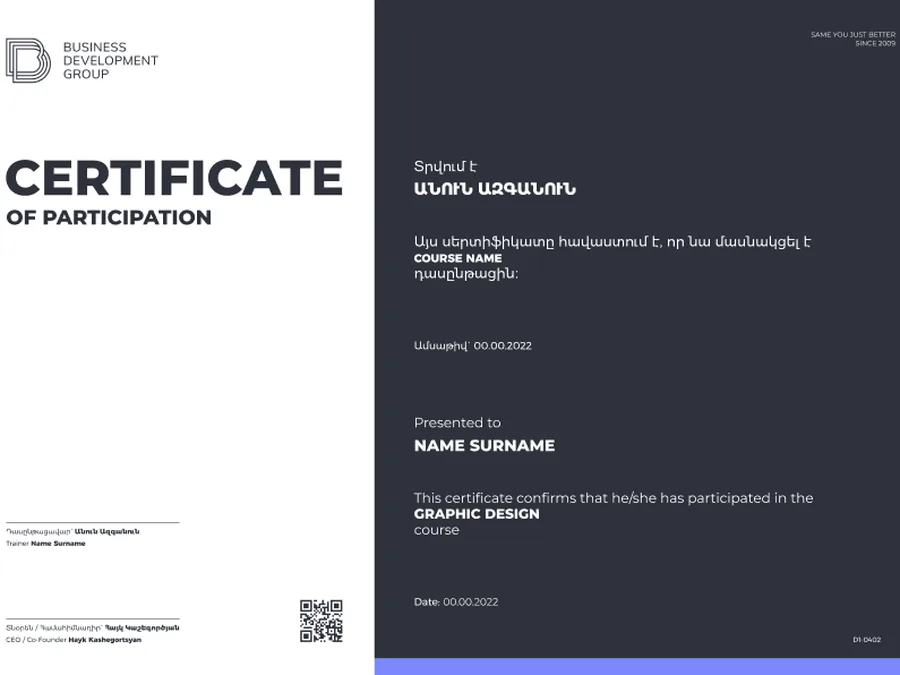
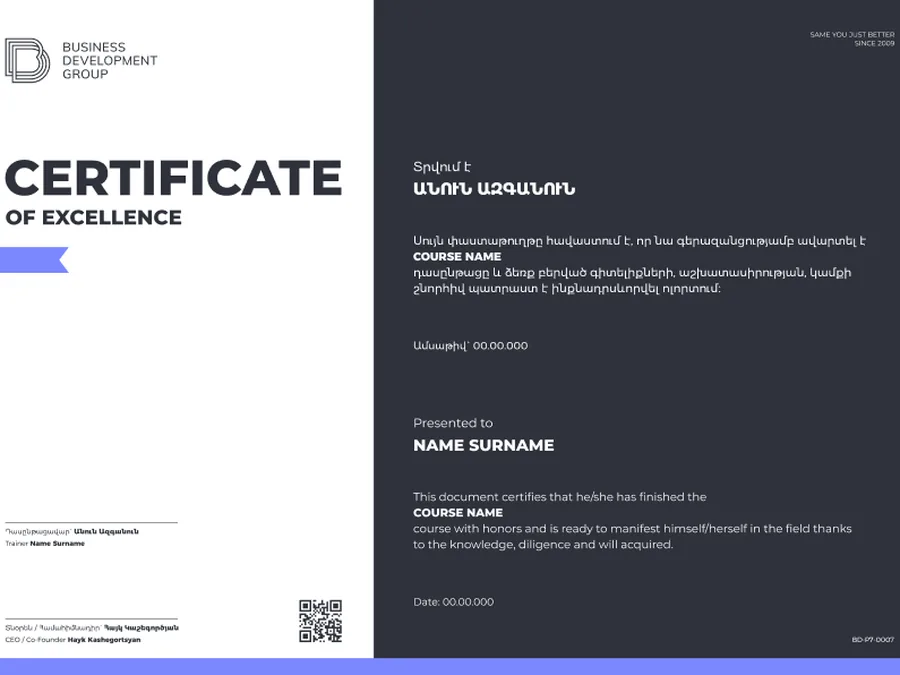
Certificates
Certificates you can receive
Depending on the course format and results, students can receive one of BDG's certificate types.
- ✓ Verified BDG certificate
- ✓ QR / signature-ready format
- ✓ Armenian & English certificate design
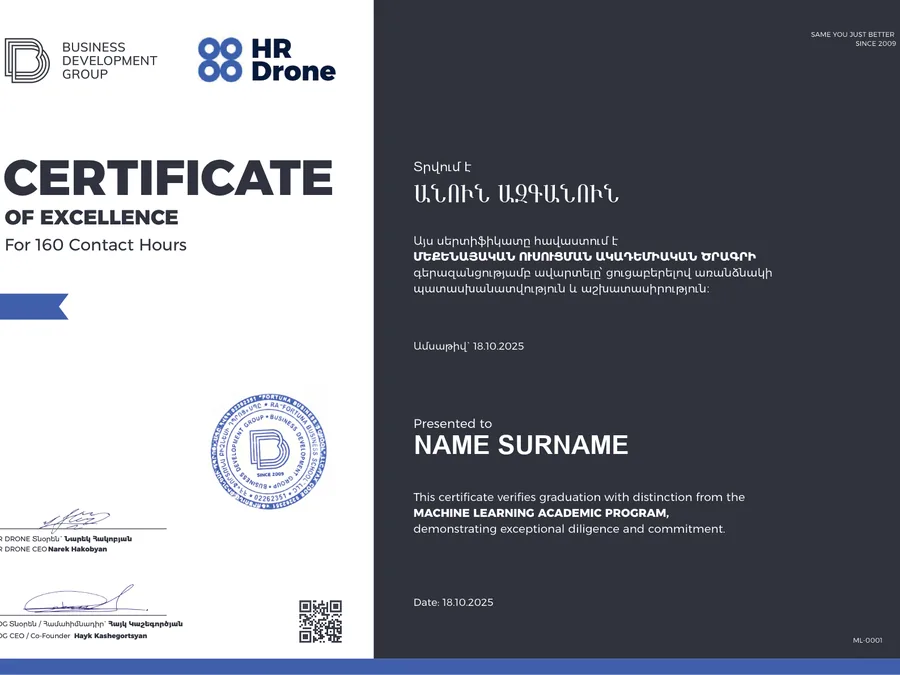 Co-branded
Participation
For students who actively participate in the course learning process.
For active participationCompletion
For students who complete the course requirements and finish the program.
For successful completionExcellence
For students who complete the course with outstanding results and strong performance.
With distinctionHR Drone
A co-branded certificate for selected HR and partner-certified programs.
Co-brandedIT and Programming
Ready to start Python Full Course: AI Powered?
Book a free consultation and reserve your place in the next cohort.
63,000 ֏
/ month
5 months · Starts — October 21, 2026
100% booked
Keep exploring
Related courses