

Data Science
·Offline
Machine Learning Academic Program
- ✓ Higher Mathematics and Probability Theory
- ✓ Python in Machine Learning
- ✓ Machine Learning Models
- ✓ Deep Learning
Free consultation · Certificate on completion · Practical learning
Duration
8 months
Format
Offline
Starts
11.04.2026
Certificate
On completion
Payment
Monthly
Price
69,000 ֏
Program
▪ Definition; operations on vectors (addition, subtraction, dot product)
▪ Euclidean and cosine distances
▪ Definition of a matrix; operations on matrices
▪ Definition of determinant; properties and computation
▪ Definition; main concepts
▪ Computation of eigenvalues; applications
▪ Introduction to complex numbers
▪ Definitions; types of diagonalization; applications
▪ Methods of definition; main classes of functions
▪ Continuity and discontinuities; properties of functions
▪ Geometric meaning; derivatives of composite and inverse functions
▪ Basic differentiation rules
▪ Antiderivative; indefinite integral; properties; main formulas
▪ Definite integral; geometric meaning; applications
▪ Domain; level curves and surfaces
▪ Limits and continuity
▪ Derivative of composite function
▪ Directional derivative; gradient
▪ Local maxima and minima
▪ Gradient descent method
▪ Classification of events; operations on events
▪ Classical and geometric probability
▪ Law of total probability; Bayes’ theorem
▪ Discrete random variables; probability mass function
▪ Numerical characteristics
▪ Bernoulli, Binomial, Poisson distributions
▪ Numerical characteristics
▪ Uniform, Normal (Gaussian), Exponential distributions
▪ Central Limit Theorem (without proof)
- Interpreter model & execution flow
- Variables and object references
- Mutability vs immutability
- int, float, str, bool
- list vs tuple
- Basic operations
- Conditionals & loops
- Function structure & readability
- Variable scope
- Default arguments
- Type hints (intro)
- Exception handling (raise / try / except)
- Lists (dynamic array intuition)
- Dictionaries (hash map intuition)
- Sets
- Stack & queue
- When to use which structure
- Operation cost intuition
- What Big-O really means
- O(1), O(n), O(log n), O(n²)
- Nested loops & growth
- Searching vs sorting cost
- Binary search idea
- Space complexity basics
- Introducing git
- Classes & objects
- init
- Instance vs class attributes
- Encapsulation
- Composition vs inheritance
- When OOP helps (and when not)
- Web Fundamentals & API Development
- Request lifecycle: what happens when you click on url
- HTTP structure
- Methods: GET, POST, PUT, DELETE
- Status codes
- Headers
- JSON
- REST principles
- Idempotency
- FastAPI setup
- Path & query parameters
- Request body & validation
- Pydantic models
- Response models
- Error handling
- Auto-generated docs (swagger)
- Process vs thread
- CPU-bound vs I/O-bound
- Blocking vs non-blocking
- Throughput vs latency
- Event loop concept
- Why synchronous servers struggle
- async / await
- Coroutines
- asyncio basics
- Running concurrent tasks
- Timeouts & retries
- Async endpoints in FastAPI
- Calling external APIs concurrently
- Production-Ready Engineering
- Password hashing basics
- JWT authentication
- Protecting endpoints
- Authorization concepts
- pytest fundamentals
- Testing API endpoints
- Mocking dependencies
- Testing async code
- Containerization purpose
- Docker fundamentals
- Writing a Dockerfile
- Logging in production
- Rate limiting concept
- Caching concept
- Health checks
- Why structure matters
- Layered design:○ API layer (HTTP handling)○ Service layer (business rules)○ Data layer (storage abstraction)
- Dependency direction
- Basic dependency injection concept
- Logging basics
- Definition and types of machine learning
- Applications in real-world scenarios
- Understanding supervised and unsupervised learning problems
- Understanding regression and classification problems
- Vectors and matrices in ML
- Feature representation and scaling
- Categorical vs numerical features
- Why linear algebra matters
- Simple linear regression
- Multiple linear regression
- Mean Squared Error (MSE) intuition
- Model fitting concept
- Gradient descent intuition
- Batch, stochastic, mini-batch gradient descent
- Learning rate importance
- Convergence behavior
- Overfitting intuition
- Ridge (L2) regression
- Lasso (L1) regression
- Elastic Net
- Train / validation / test split
- Cross-validation techniques
- Bias–variance tradeoff
- Overfitting vs underfitting
- Classification workflow
- Decision boundaries
- When regression is insufficient
- Sigmoid function intuition
- Binary classification
- Cross-entropy loss
- Probabilistic interpretation
- Accuracy limitations
- Precision, Recall, F1 score
- Confusion matrix
- ROC curve & AUC
- Distance-based intuition
- Algorithm behavior in high dimensions
- Choosing k
- Practical applications
- Naïve Bayes classifier
- Conditional independence assumption
- Generative vs discriminative models
- Linear Discriminant Analysis (LDA) intuition
- Quadratic Discriminant Analysis (QDA) intuition
- Gaussian class assumptions
- Maximum margin intuition
- Soft-margin SVM
- Kernel idea (conceptual, no heavy math)
- When to use SVM
- Class imbalance problem
- Precision-recall tradeoffs
- Resampling and weighting strategies
- Data augmentation intuition
- Tree-based decision making
- Regression vs classification trees
- Splitting criteria intuition
- Overfitting and pruning
- Bootstrap sampling
- Bagging concept
- Random Forest algorithm
- Feature randomness
- Boosting intuition
- AdaBoost
- Gradient Boost
- How boosting reduces bias
- Why modern boosting frameworks are faster
- Handling categorical and missing data
- Feature importance and interpretability
- Practical usage tips
- Clustering vs dimensionality reduction
- Similarity and distance measures
- High-level workflow
- K-means algorithm intuition
- Initialization challenges
- Mini-batch K-means
- Cluster interpretation
- DBSCAN intuition
- Spectral clustering concept
- Advantages over K-means
- Cluster evaluation strategies
- Why scaling matters
- Normalization intuition
- Initialization
- Overfitting
- Dropout concept
- Batch normalization intuition
- Momentum
- RMSprop
- Adam (why it became default)
- Convolution intuition
- Receptive field concept
- Pooling idea
- Why CNNs were revolutionary
- Transfer learning with pretrained CNNs
- U-Net concept (segmentation intuition)
- Sequence modeling (next token prediction)
- Recurrent Neural Networks
- Why RNNs Struggle
- LSTM / GRU - What they fixed
- Why scaling RNNs was difficult
- Parallelization limitations
- Attention
- Why attention solves RNN limitations
- Transformer Architecture Idea
- GPT-style autoregressive models
- BERT-style masked models
- Generator vs discriminator game (loss function)
- Why training is unstable
- Why diffusion models replaced them in many applications
- Where GANs are still useful
- Embeddings as semantic representations
- Cosine similarity & vector distance intuition
- Dense vs sparse retrieval
- Hybrid search (keyword + vector)
- Approximate Nearest Neighbors (ANN, HNSW intuition)
- Vector databases & metadata filtering
- Indexing, retrieval pipeline
- Retrieval quality evaluation
- Why LLMs hallucinate
- Retrieval-before-generation paradigm
- Standard RAG architecture
- Chunking strategies & context optimization
- Query rewriting & re-ranking
- Faithfulness & groundedness evaluation
- Production RAG patterns
- Modern chat-based LLM APIs
- Model selection & temperature control
- Prompt design patterns (instruction, role, few-shot)
- Structured outputs (JSON schemas)
- Function / tool calling
- Streaming responses
- Rate limits, retries & token budgeting
- Deterministic LLM pipelines
- What defines an AI agent
- ReAct reasoning pattern
- Tool-use architecture
- Memory (context + vector memory)
- Task decomposition & orchestration loops
- Agent failure modes & debugging
- Guarded tool execution
- Practical example e.g. trading/financial agent
- Evaluating generative systems
- LLM-as-a-judge
- Hallucination mitigation strategies
- Prompt injection defenses
- Output guardrails
- Monitoring & logging in production
- Continuous evaluation pipelines
- Multimodal foundation models
- Vision-language systems & multimodal embeddings
- Diffusion model intuition
- Serving LLMs in production
- Async orchestration & parallel calls
- Caching, batching & background workers
- Cost-performance tradeoffs
- AI workflow automation design
Why Join the Course?
Why participate in the “Machine Learning Academic Program”?
The course is designed for those who have basic mathematical knowledge and want to acquire one of the most demanded professions today. After graduation, the student will be able to work in the field of artificial intelligence as a machine learning researcher. Will be able to apply mathematical methods in the context of solving certain problems (for example, data processing, forecasting and modeling). Basic knowledge of mathematics and basic computer usage are required to participate in the course. The course is organized into 3 main blocks: higher mathematics, Python programming language and Machine Learning. After graduation, students will be able to build various types of products using the algorithms and models they have already learned during the course. This is an opportunity to start a promising career as an ML/AI researcher.Get 5% Cashback
Pay with  QR Code
- 1 Pay the tuition by bank transfer in your own name.
- 2 Receive the electronic settlement document confirming the payment.
- 3 File your annual income declaration and include the tuition expense.
- 4 Once approved, the amount is refunded to your bank account.
Who is this course for
-
✓
For Beginners
For anyone who wants to gain practical and real-world knowledge about Machine Learning and become a Machine Learning Engineer, Data Scientist, or Data Analyst.
-
✓
For IT Professionals
Developers, data analysts, and professionals with basic machine learning knowledge who want to deepen their knowledge in the field of machine learning.
What you will learn
- ✓Higher Mathematics and Probability Theory
- ✓Python in Machine Learning
- ✓Machine Learning Models
- ✓Deep Learning
- ✓Neural Networks
Ready to join this course?
Secure your place and take the next step in your professional growth.
Frequently asked questions
Each course is labelled beginner, intermediate or advanced. If you are unsure, book a free consultation and we will help you choose.
Flexible payment options are available for most programs. Contact us to discuss the right plan for you.
We mostly hold trainings with a Project Based Learning approach. Thanks to this approach, the students gain practical knowledge and develop their proficiency in the most efficient way.
After each training the students pass exams. Thus, both students and trainers have the opportunity to clearly assess the effectiveness of the training. Based on the results of the exams the students get certificates.
Upon completion of the training we give certificates to our students. Moreover, those whose performance is above 80% receive certificates of excellence.
We have developed a partner network that includes current best employers. In cooperation with them we do our best to assist our students in finding jobs. This network also helps us to organise internships for our students after the trainings.
Payment for the courses is made after the first lesson until the second lesson, in cash or by transfer. Payment for each stage is made for a fixed amount of 8 lessons.
Our courses are held in 2 main formats: online and offline. We believe that maintaining the format is very important for the effectiveness of the course.
BDG classrooms are technically equipped, and if necessary, we also provide students with laptops.
There is a break during each course, during which you can have a coffee and tea break.
HR consulting is carried out with our Career Development Specialist. With him, you can discuss your CVs, make corrections and finalize them, ready to apply for jobs.
All course materials, including recordings, books provided by trainers and other educational materials, are constantly available to our students during the course.
Individual courses are not currently designed, based on market needs and demands. During group courses, participants are also actively involved in teamwork, develop their communication skills, and learn to work in a team.
There is no age limit as such, as we value the spread of education to all age groups. It is especially important for us that people who already have experience and knowledge and want to acquire a new profession also go into a new educational direction.
Admission to each course is carried out through an interview or a test, or both at the same time. The choice of admission method depends on the requirements and specifics of the course.
We provide technical support to all our students related to the operational work of computers, as well as technical issues. The support is provided by our employee within the framework of the course.
Our team is in constant contact with students to provide the information you need, if necessary.
Certificates
Certificates you can receive
Depending on the course format and results, students can receive one of BDG's certificate types.
- ✓ Verified BDG certificate
- ✓ QR / signature-ready format
- ✓ Armenian & English certificate design
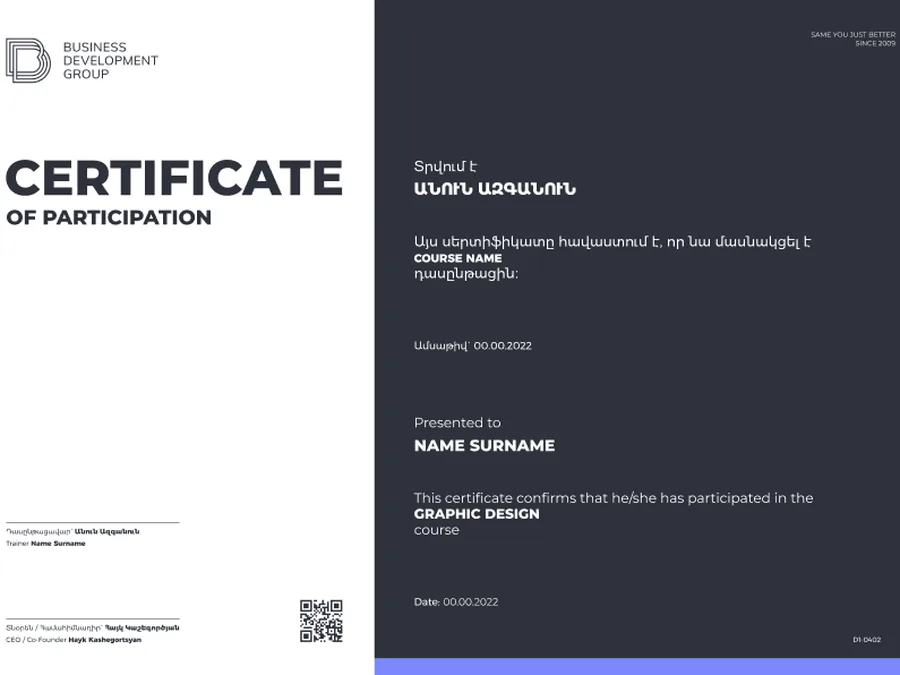
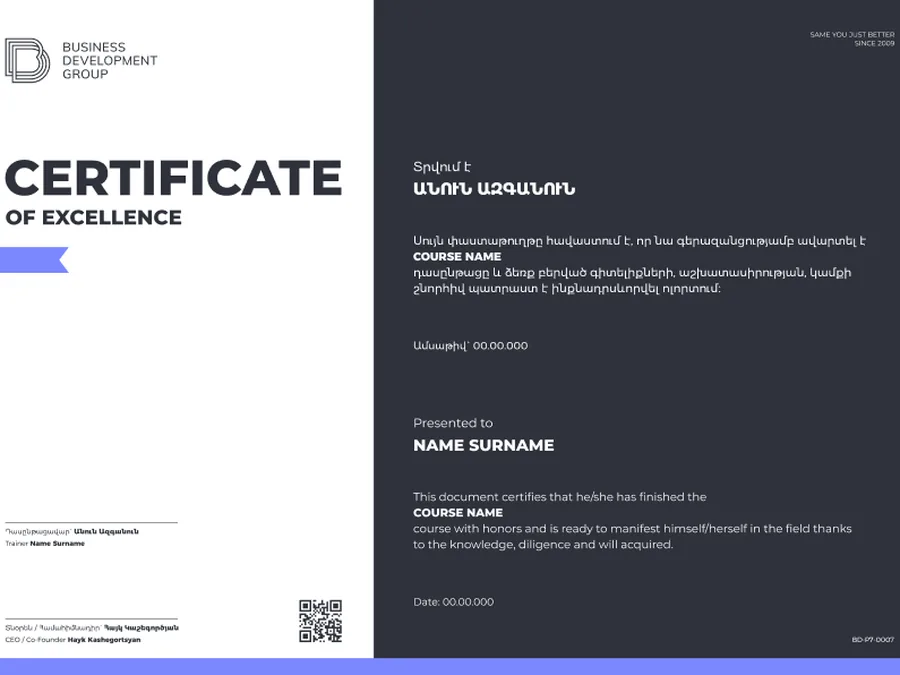
 Co-branded
Participation
For students who actively participate in the course learning process.
For active participationCompletion
For students who complete the course requirements and finish the program.
For successful completionExcellence
For students who complete the course with outstanding results and strong performance.
With distinctionHR Drone
A co-branded certificate for selected HR and partner-certified programs.
Co-brandedData Science
Ready to start Machine Learning Academic Program?
Book a free consultation and reserve your place in the next cohort.
69,000 ֏
8 months · Starts — April 11, 2026
Keep exploring
Related courses