
IT and Programming
·Offline
QA Automation with JAVA
- ✓ Java basics
- ✓ Object-oriented programming
- ✓ Selenium basics
- ✓ An overview of the entire testing process
Free consultation · Certificate on completion · Practical learning
Duration
3 months
Format
Offline
Starts
14.05.2024
Certificate
On completion
Payment
Monthly
Price
63,000 ֏
Program
Opportunities after this course
- Java History
- Why Java
- What you can implement with Java
- What is JVM
- What is JRE
- What is JDK
- What is IDE
- What are the most popular IDE for Java development
- What data types exist in Java
- What are primitive types
- Integers
- Floating-point numbers
- Characters
- Boolean
- Primitive types conversion
- What are variables
- What is a function
- Function signature
- How to declare a function
- How to call the function
- Function overloading
- Pass arguments by value
- Java.lang. String class overview
- Main String methods
- How to create String objects
- How to format string
- When do we need to format strings?
- Arrays: overview
- How to access elements in arrays
- Array Index Out Of Bounds Exception
- List Interface: Overview
- ArrayList
- How to sort elements in List
- Overview of Map and Set implementations
- What are operators?
- Type of operators
- Arithmetic operators
- Assignment operators
- Logical operators
- Ternary operato
- 'for' with condition loop
- 'while' loop
- 'do-while' loop
- 'for each' loop
- What is a debugger
- Why do we need to debug our programs
- How to analyze program execution
- What are breakpoints
- Classes & Objects
- Fields
- Initialization blocks
- Constructors
- Methods
- Getters and setters
- toString() method
- How to create an object
- What is inheritance
- ‘super’ keyword
- ‘instanceof’ operator
- How to extend classes
- Inheritance rules
- What is polymorphism
- Method overriding
- Override VS Overload
- ‘final’ keyword
- 'static' keyword
- What is encapsulation
- Access modifiers
- Which modifiers to use and when
- Rules during overriding
- Abstract classes
- Abstract keyword
- What are interfaces
- Abstract class VS Interface
- Create a new Maven Project and all Framework dependencies
- Selenium Program on WebDriverManager
- Implementation of an explicit wait to handle application synchronously on loading
- What are Chrome Dev tools? Why do we need this for Selenium testing?
- Understand Device metrics override function to simulate browser as mobile
- Importance of locators in Selenium WebDriver to identify the elements
- Identifying the Web elements with ID and name locators
- Introducing Class names and Css Selector locators to identify elements
- Working with Xpath and linktext locators and different ways of writing xpaths
- Building Customized Xpath and Css Selector locators based on html attributes
- Why TestNG and Its Advantages
- Importance of xml file in Testng configuration
- Prioritizing the Test Cases with TestNG
- Include and Exclude Mechanisms to control test cases
- TestNG Annotations
- Usage of Groups functionality in TestNG
- Annotations helper attributes with examples
- What is the Page object model? Advantages of its implementation
- Creating Page Object Classes
- Implementing Action methods for web elements to implement logic
- Creating Abstract Components to reuse the common methods/code in a framework
- Creating common methods for Abstract components and extending them in Page classes
- Wrapping up the whole test with complete refactoring into a Page object model
- What is Cross-browser Testing on the Cloud?
- Running the tests in cross-browser and how to inspect objects in Chrome & Firefox
- BrowserStack Support to run tests
Why Join the Course?
Why take the QA Automation with Java course?
In the contemporary tech industry, proficiency in automation tools is a prerequisite for testing specialists, as relying solely on Manual QA is no longer sufficient for driving projects forward efficiently. Automation QA is vital for streamlining testing processes, allowing for more efficient execution of long-term, extensive projects. The Automation QA with Java course is open to both beginners and seasoned Manual QA specialists seeking to dive into test automation. Throughout the course, participants will delve into:- Fundamental principles of Java programming and automation tools;
- Stages of automation, supported by real project examples, including proficiency in the Selenium framework;
- The QA automation workflow, collaboration with fellow QA professionals and developers, and a comprehensive understanding of key responsibilities.
Get 5% Cashback
Pay with  QR Code
- 1 Pay the tuition by bank transfer in your own name.
- 2 Receive the electronic settlement document confirming the payment.
- 3 File your annual income declaration and include the tuition expense.
- 4 Once approved, the amount is refunded to your bank account.
Who is this course for
-
✓
Beginner level Manual QA specialists
This course is designed for beginner Manual QA specialists, even those without prior work experience, aiming to enhance their skills and gain a solid foundation in QA Automation.
-
✓
Experienced QA Professionals
For those already established in their roles as Manual QA specialists, the Automation QA course serves as a valuable resource. Participation in this course empowers experienced professionals to boost the efficiency of their current roles, undertake more advanced assignments, and move forward in their careers.
Ready to join this course?
Secure your place and take the next step in your professional growth.
Frequently asked questions
Each course is labelled beginner, intermediate or advanced. If you are unsure, book a free consultation and we will help you choose.
Flexible payment options are available for most programs. Contact us to discuss the right plan for you.
We mostly hold trainings with a Project Based Learning approach. Thanks to this approach, the students gain practical knowledge and develop their proficiency in the most efficient way.
After each training the students pass exams. Thus, both students and trainers have the opportunity to clearly assess the effectiveness of the training. Based on the results of the exams the students get certificates.
Upon completion of the training we give certificates to our students. Moreover, those whose performance is above 80% receive certificates of excellence.
We have developed a partner network that includes current best employers. In cooperation with them we do our best to assist our students in finding jobs. This network also helps us to organise internships for our students after the trainings.
Payment for the courses is made after the first lesson until the second lesson, in cash or by transfer. Payment for each stage is made for a fixed amount of 8 lessons.
Our courses are held in 2 main formats: online and offline. We believe that maintaining the format is very important for the effectiveness of the course.
BDG classrooms are technically equipped, and if necessary, we also provide students with laptops.
There is a break during each course, during which you can have a coffee and tea break.
HR consulting is carried out with our Career Development Specialist. With him, you can discuss your CVs, make corrections and finalize them, ready to apply for jobs.
All course materials, including recordings, books provided by trainers and other educational materials, are constantly available to our students during the course.
Individual courses are not currently designed, based on market needs and demands. During group courses, participants are also actively involved in teamwork, develop their communication skills, and learn to work in a team.
There is no age limit as such, as we value the spread of education to all age groups. It is especially important for us that people who already have experience and knowledge and want to acquire a new profession also go into a new educational direction.
Admission to each course is carried out through an interview or a test, or both at the same time. The choice of admission method depends on the requirements and specifics of the course.
We provide technical support to all our students related to the operational work of computers, as well as technical issues. The support is provided by our employee within the framework of the course.
Our team is in constant contact with students to provide the information you need, if necessary.
Certificates
Certificates you can receive
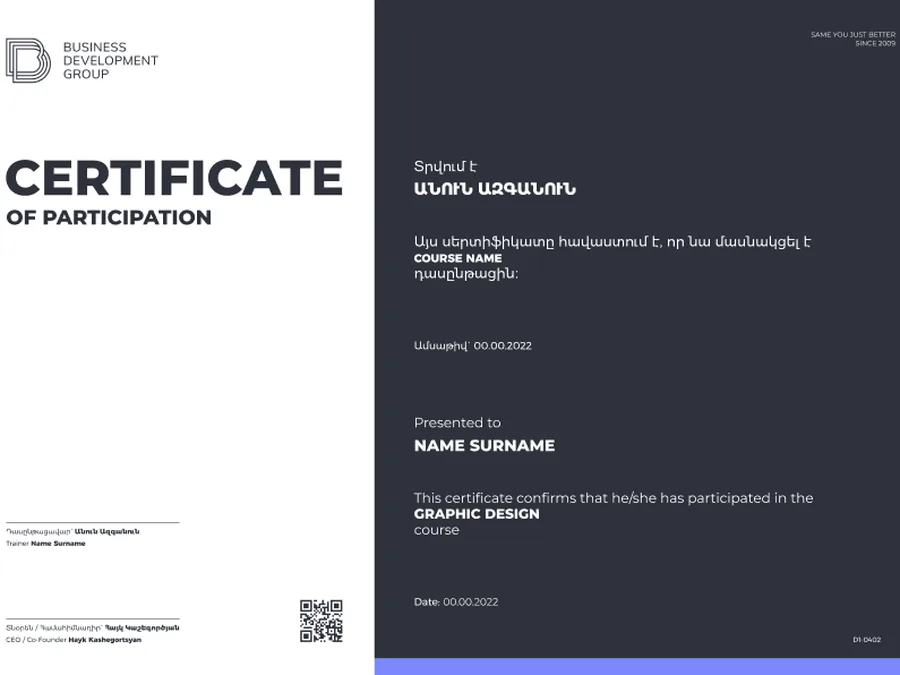
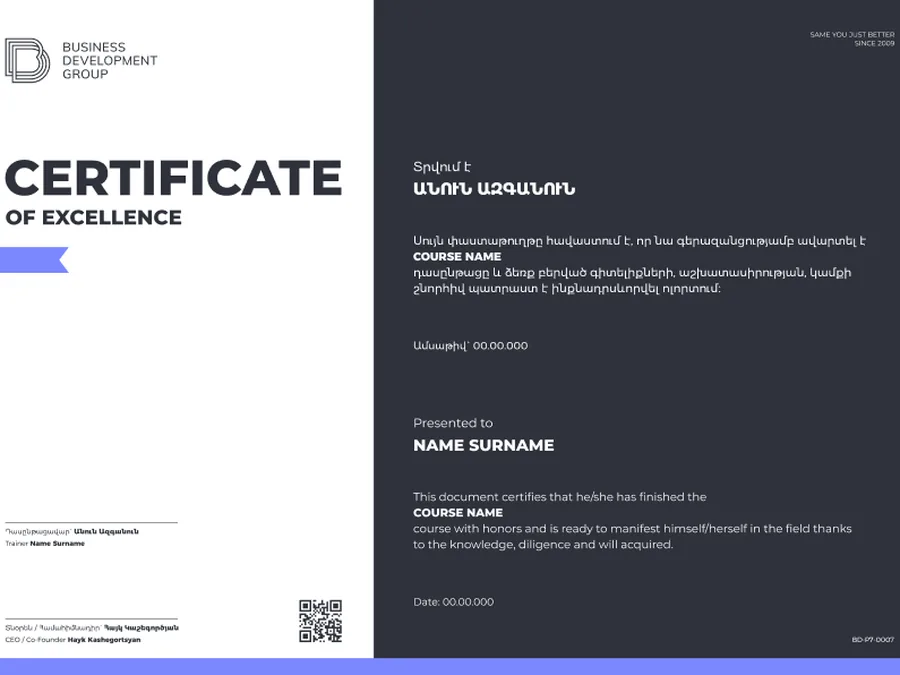
Depending on the course format and results, students can receive one of BDG's certificate types.
- ✓ Verified BDG certificate
- ✓ QR / signature-ready format
- ✓ Armenian & English certificate design
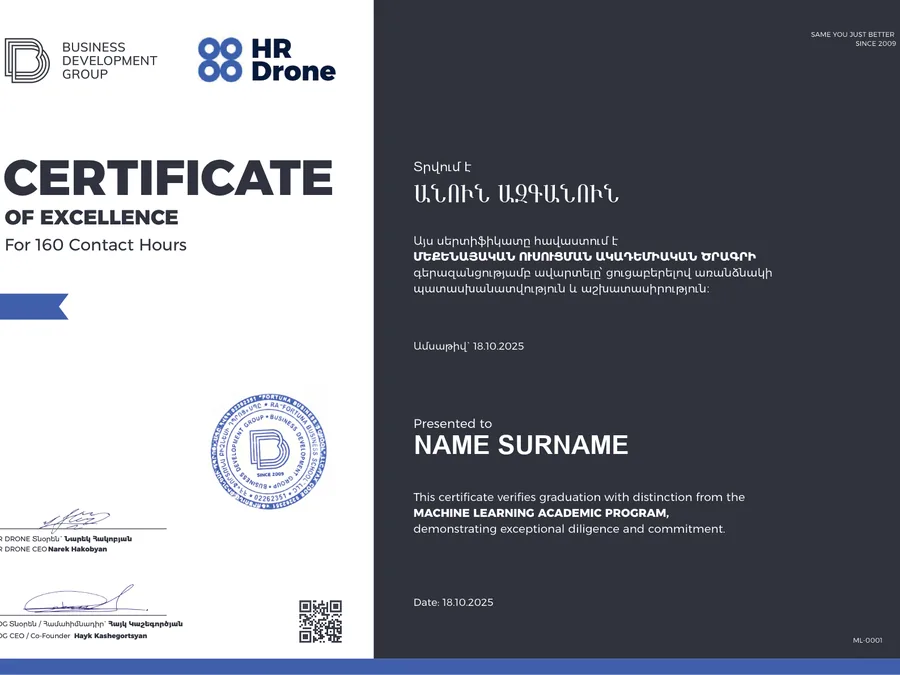 Co-branded
Participation
For students who actively participate in the course learning process.
For active participationCompletion
For students who complete the course requirements and finish the program.
For successful completionExcellence
For students who complete the course with outstanding results and strong performance.
With distinctionHR Drone
A co-branded certificate for selected HR and partner-certified programs.
Co-brandedIT and Programming
Ready to start QA Automation with JAVA?
Book a free consultation and reserve your place in the next cohort.
63,000 ֏
3 months · Starts — May 14, 2024
Keep exploring
Related courses