IT and Programming
·Offline
DevOps Full Course
- ✓ Linux, AWS, and Kubernetes
- ✓ Applying AI tools in DevOps (AIOps)
- ✓ Infrastructure automation with AWS and Terraform
- ✓ Automation scripting
Free consultation · Certificate on completion · Practical learning
Duration
6 months
Format
Offline
Level
Beginner
Starts
04.07.2026
Certificate
On completion
Payment
Monthly
Price
69,000 ֏
Program
- Methodology: Agile, Scrum, and the SDLC (Software Development Life Cycle)
- The Kernel, Shell, and File System hierarchy
- Critical Commands: grep, awk, sed, curl, lsof
- Scripting: Writing Bash scripts, Shebang, variables, and loops
- Permissions & Ownership (chmod, chown, sudo)
- Process Management (Systemd, journalctl, kill)
- Practice Homework 1: The "Fix It" Script. Given a broken Linux VM (simulated), write a bash script that fixes permissions, restarts a crashed service, and archives logs older than 7 days.
- Git Internals (Commit, Push, Pull)
- Repository initialization and management
- Handling .gitignore and file tracking
- Advanced Branching: GitFlow vs. Trunk-Based Development
- Resolving Merge Conflicts
- Pull Requests & Code Reviews (Best Practices)
- Practice Homework 2
- Python Syntax Basics (Variables, Data Types, Loops)
- Functions and modular code
- Moving beyond Bash: When to use Python vs. Bash?
- Working with OS paths and Files (os, sys, shutil libraries)
- Handling JSON/YAML data structures in Python
- Scripting automation logic
- Using the requests library to interact with REST APIs
- Intro to boto3 (AWS SDK for Python)
- Writing a log parser script (Mini Project)
- DNS, HTTP/HTTPS protocols
- IP Addressing and Subnetting
- CIDR blocks and Masking (Preparation for VPC)
- Virtual Machines vs. Containers (Architecture comparison)
- Docker Components (Daemon, Client, Registry)
- Running Nginx containers hands-on
- Docker Images structure (Layers, Caching)
- Artifact Management: Intro to Nexus/Artifactory vs. AWS ECR
- Image Optimization and Distroless images
- The Dockerfile: Best practices
- Multi-stage builds for a smaller footprint
- Environment variables and arguments
- Docker Compose: Frontend + Backend + DB setup
- Docker Networking (Bridge, Host, Overlay)
- Docker Volumes and Data Persistence
- Practice Homework 4: Containerize the Monolith
- Agentless Architecture
- Inventory management (Static vs Dynamic)
- Connecting to remote hosts
- Writing Playbooks with YAML
- Ansible Modules
- Use Case: Bootstrapping a server with security patches
- Practice Homework 5: Server Bootstrap
- Cloud Models (IaaS, PaaS, SaaS)
- AWS Global Infrastructure (Regions, Availability Zones)
- The Shared Responsibility Model
- IAM Roles, Policies, and Users
- Security Groups and NACLs
- The Principle of Least Privilege
- VPC Deep Dive (Subnets, Route Tables)
- Internet Gateways and NAT Gateways
- Public vs. Private Subnets
- Practice Homework 6: Manual VPC Build
- HCL Basics (HashiCorp Configuration Language)
- Providers and Resources
- Lab: Provisioning a VPC with Terraform
- AWS EC2 Types & Lifecycle
- AWS S3 (Versioning, Storage Classes)
- AWS RDS (Relational Database Service)
- Managing State (Remote Backend with S3)
- State Locking (DynamoDB)
- Data Sources (Querying existing infrastructure)
- Load Balancers (ALB vs NLB)
- Auto Scaling Groups (ASG) configurations
- Health Checks and Target Groups
- Terraform Modules (Reusability)
- Dynamic Blocks and Loops
- Lab: Deploying an auto-scaling cluster via IaC
- Practice Homework 7: The Module Creator
- Handling Secrets (AWS Secrets Manager vs. HashiCorp Vault)
- DNS Management with Route53
- Certificate Management (ACM)
- Comparison: AWS concepts mapping to GCP/Azure
- Disaster Recovery strategies
- Review of IaC Architecture
- K8s Architecture (Control Plane vs. Worker Nodes)
- K8s Object Model
- Setting up a local cluster (Minikube/Kind)
- Pods and ReplicaSets
- Deployments and Rolling Updates
- Namespaces and Resource Quotas
- Services: ClusterIP, NodePort, LoadBalancer
- Ingress Controllers (Nginx Ingress)
- Service Discovery within the cluster
- ConfigMaps & Secrets management
- Storage Classes & Persistent Volumes (PVC/PV)
- Lab: Deploying a Stateful Application
- Practice Homework 8: K8s Manifests
- Helm Architecture
- Charts, Values, and Releases
- Managing dependencies with Helm
- Continuous Integration vs. Continuous Delivery vs. Deployment
- Introduction to Jenkins (Master/Agent architecture)
- Build Tools Overview: Maven/Gradle concepts (Theoretical touchpoint)
- Push vs. Pull deployment models
- ArgoCD: Architecture and Installation
- Syncing K8s state with Git repositories
- Jenkins vs. GitLab CI vs. GitHub Actions
- Writing a .gitlab-ci.yml pipeline
- Pipeline triggers and stages
- Jenkins Shared Libraries (DRY code)
- Multi-branch pipelines
- Scripted vs. Declarative syntax
- Practice Homework 9: The CI/CD Link
- Integrating SonarQube (Code Quality)
- Container Security: Snyk / Trivy
- Automated testing in pipelines
- Vertex AI (GCP) & Bedrock (AWS) overview
- Provisioning AI models via Terraform
- Managing AI quotas and costs
- Using AI to analyze logs and predict failures
- GitHub Copilot/CodeWhisperer for writing IaC
- Prompt Engineering for DevOps
- The 3 Pillars: Logs, Metrics, Traces
- Prometheus Architecture
- Grafana Dashboards visualization
- AlertManager configuration
- Defining Alerting rules
- PagerDuty/OpsGenie concepts
- Practice Homework 10: The Watchtower
- Scenario: "Migration of a Monolith to Microservices"
- Architecture Design Session
- Containerizing the Python Application
- Full Deployment: TF + K8s + ArgoCD + AI Log Analyzer
- Project Presentation and Code Review
- Career Advice & Next Steps
Why Join the Course?
Why participate in the "DevOps for Beginners" course?
The course is designed and developed for anyone who wants to work in the IT industry in a highly in-demand profession. By the end of the course, students will gain hands-on experience with essential tools such as Linux, AWS, and Kubernetes, as well as learn how to use AI tools to automate workflows and make operations more efficient. After graduation, students will be prepared to work as Junior DevOps Engineers, Cloud Engineers, Site Reliability Engineers (SRE), or Platform Engineers.Get 5% Cashback
Pay with  QR Code
- 1 Pay the tuition by bank transfer in your own name.
- 2 Receive the electronic settlement document confirming the payment.
- 3 File your annual income declaration and include the tuition expense.
- 4 Once approved, the amount is refunded to your bank account.
Who is this course for
-
✓
Entry-level professionals
The course is intended for individuals who want to enter the IT field and start a career as a Junior Engineer.
-
✓
System Administrators (SysAdmins) and Network Administrators
The program is also suitable for IT professionals currently working as system or network administrators who want to transition into a DevOps engineering role.
-
✓
Software Developers
Developers who want to gain a deeper understanding of infrastructure and cloud technologies are also welcome to join the course.
What you will learn
- ✓Linux, AWS, and Kubernetes
- ✓Applying AI tools in DevOps (AIOps)
- ✓Infrastructure automation with AWS and Terraform
- ✓Automation scripting
- ✓Software delivery: CI/CD and GitOps using Jenkins, GitLab CI, and Argo CD
Ready to join this course?
Secure your place and take the next step in your professional growth.
Frequently asked questions
Each course is labelled beginner, intermediate or advanced. If you are unsure, book a free consultation and we will help you choose.
Flexible payment options are available for most programs. Contact us to discuss the right plan for you.
We mostly hold trainings with a Project Based Learning approach. Thanks to this approach, the students gain practical knowledge and develop their proficiency in the most efficient way.
After each training the students pass exams. Thus, both students and trainers have the opportunity to clearly assess the effectiveness of the training. Based on the results of the exams the students get certificates.
Upon completion of the training we give certificates to our students. Moreover, those whose performance is above 80% receive certificates of excellence.
We have developed a partner network that includes current best employers. In cooperation with them we do our best to assist our students in finding jobs. This network also helps us to organise internships for our students after the trainings.
Payment for the courses is made after the first lesson until the second lesson, in cash or by transfer. Payment for each stage is made for a fixed amount of 8 lessons.
Our courses are held in 2 main formats: online and offline. We believe that maintaining the format is very important for the effectiveness of the course.
BDG classrooms are technically equipped, and if necessary, we also provide students with laptops.
There is a break during each course, during which you can have a coffee and tea break.
HR consulting is carried out with our Career Development Specialist. With him, you can discuss your CVs, make corrections and finalize them, ready to apply for jobs.
All course materials, including recordings, books provided by trainers and other educational materials, are constantly available to our students during the course.
Individual courses are not currently designed, based on market needs and demands. During group courses, participants are also actively involved in teamwork, develop their communication skills, and learn to work in a team.
There is no age limit as such, as we value the spread of education to all age groups. It is especially important for us that people who already have experience and knowledge and want to acquire a new profession also go into a new educational direction.
Admission to each course is carried out through an interview or a test, or both at the same time. The choice of admission method depends on the requirements and specifics of the course.
We provide technical support to all our students related to the operational work of computers, as well as technical issues. The support is provided by our employee within the framework of the course.
Our team is in constant contact with students to provide the information you need, if necessary.
Certificates
Certificates you can receive
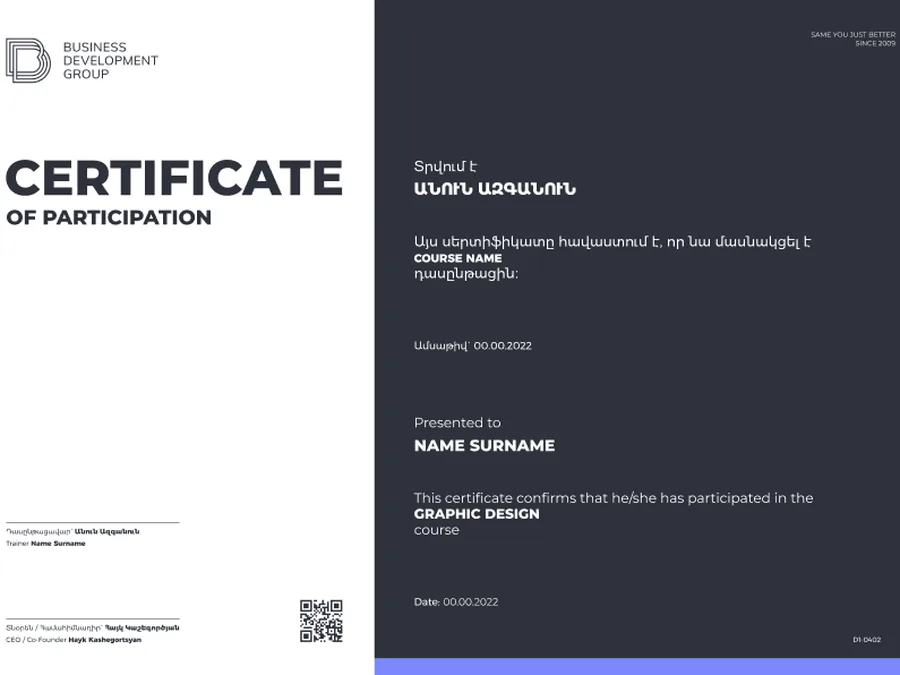
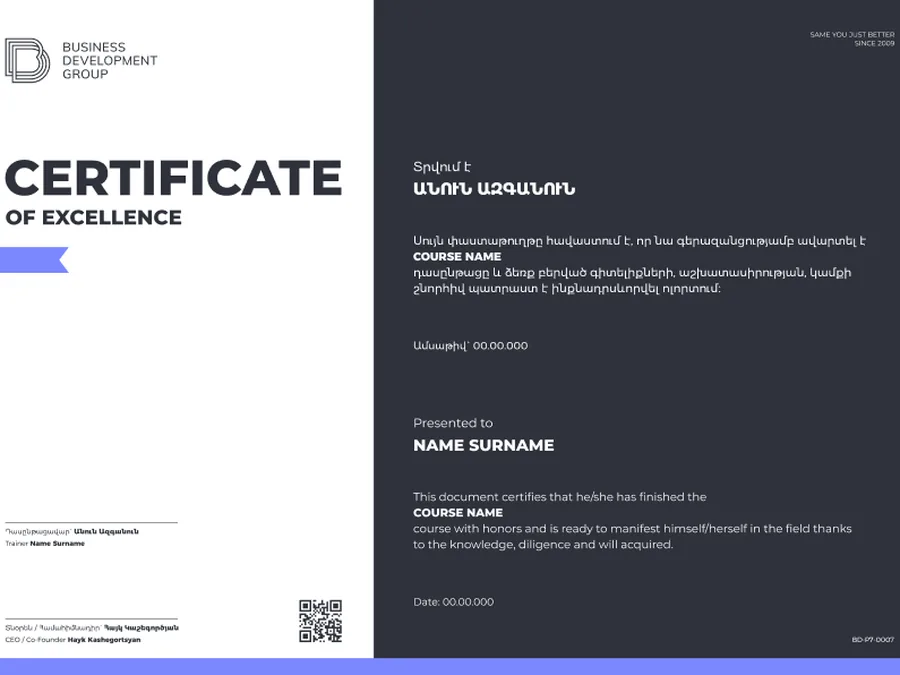
Depending on the course format and results, students can receive one of BDG's certificate types.
- ✓ Verified BDG certificate
- ✓ QR / signature-ready format
- ✓ Armenian & English certificate design
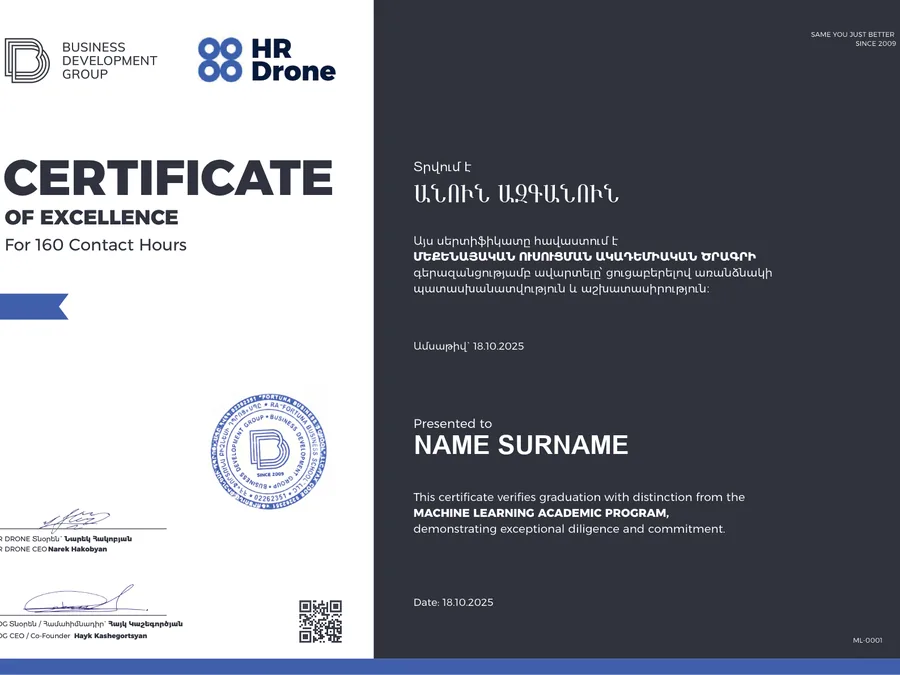 Co-branded
Participation
For students who actively participate in the course learning process.
For active participationCompletion
For students who complete the course requirements and finish the program.
For successful completionExcellence
For students who complete the course with outstanding results and strong performance.
With distinctionHR Drone
A co-branded certificate for selected HR and partner-certified programs.
Co-brandedIT and Programming
Ready to start DevOps Full Course?
Book a free consultation and reserve your place in the next cohort.
69,000 ֏
6 months · Starts — July 04, 2026
Keep exploring
Related courses