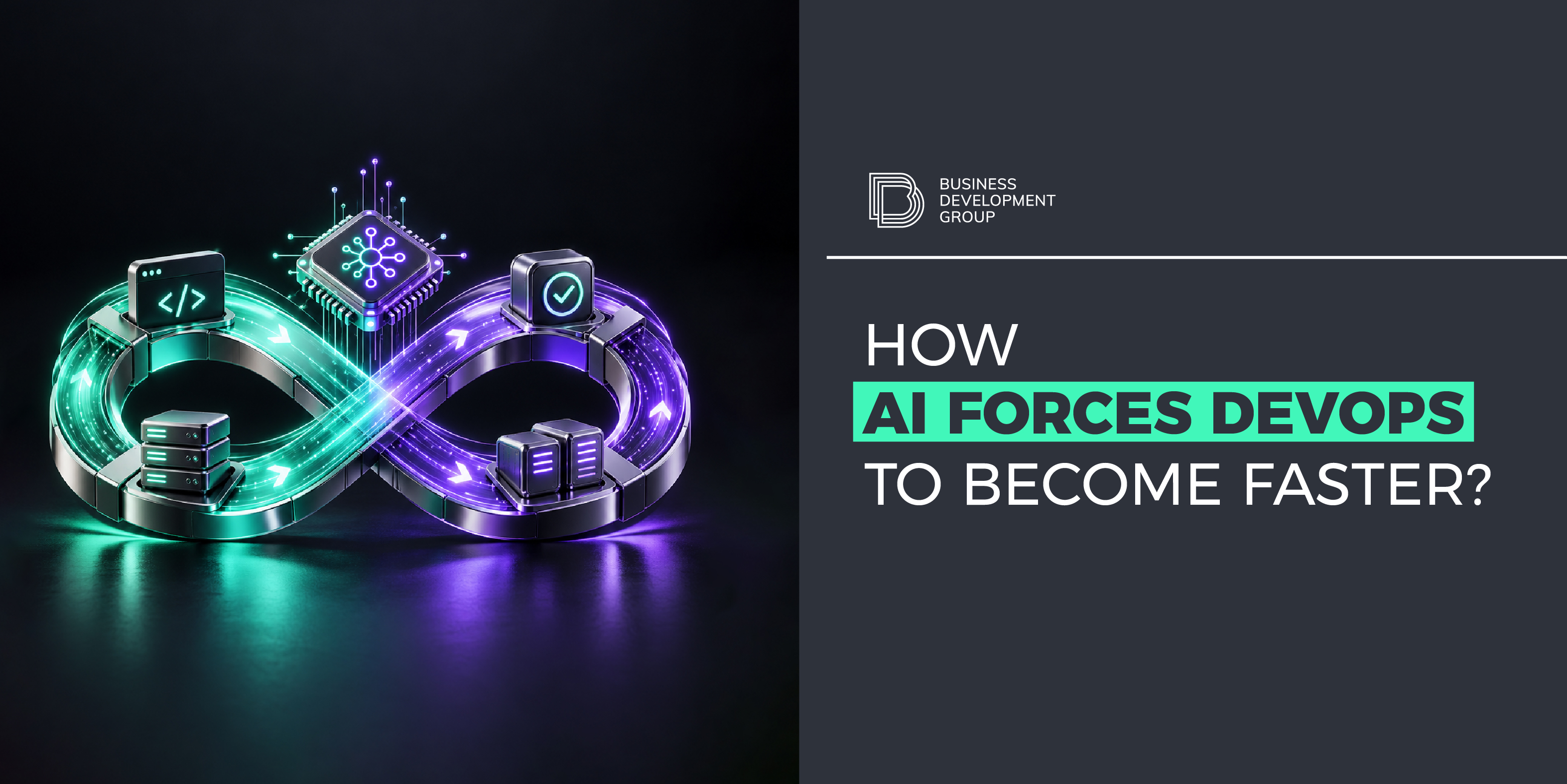
AI is defining DevOps turning manual processes into intelligent, self-optimizing systems. Considering predictive analytics, automated debugging, and real-time insights, teams may shift from firefighting issues to driving innovation.
In this blog we discuss the increasing necessity for DevOps to keep Aup with AI development cycles, why AI compels DevOps to speed up, and how solutions such as Terraform on AWS, cloud governance and cloud cost optimization enter the picture to oversee the increasing velocity of software development.
Best Actions while automating DevOps processes
Together with AI, DevOps pipelines are becoming more adaptive and efficient. Event-driven architectures respond instantly to change, reducing downtime, while AI-powered CI/CD tools accelerate delivery and maintain top-tier code quality.
1. Automating responses to system events with event-driven architects - event-driven architectures (EDAs) empower applications to respond instantly to real-time data changes, enhancing agility and scalability. With AI integrated, these systems become even smarter. They optimize event processing, detect anomalies before they escalate, and enable predictive automation, keeping operations one step ahead. The key benefits here are faster issue resolution, improved scalability and predictive analytics.
2. Infrastructure as Code (IaC): automating infrastructure deployment - Infrastructure as Code (IaC) enables software teams to define and manage infrastructure through machine-readable scripts, eliminating manual setup. With AI integration, IaC becomes even more powerful. It optimizes deployment configurations, detects misconfigurations before they cause issues, and ensures more reliable, efficient infrastructure management. Here technical teams get reduced configuration drift, enhanced security compliance and faster provisioning.
3. AI-Enhanced developer tools: boosting productivity and code quality – AI-Powered tools are transforming software development. They automate coding, debugging and testing processes, reducing the cognitive load on developers. This allows developers to focus on more strategic tasks. From all this the team gets the followings: increased development speed, improved code quality and enhanced collaboration.
4. Role of feedback loops in AI-Driven DevOps - continuous feedback loops are a cornerstone of modern DevOps, allowing teams to refine software through real-time performance insights. AI-powered analytics elevate these loops by uncovering inefficiencies, forecasting potential failures, and providing actionable recommendations. This drives continuous improvement and optimizes system performance. Here developers and DevOps teams get proactive issue detection, optimized deployment strategies and reduced deployment failures.
5. Securing AI APIs in DevOps pipelines – AI APIs are pivotal in DevOps, automating tasks and driving efficiency, but they also bring potential security risks. To safeguard these APIs, strong authentication, continuous monitoring and advanced anomaly detection are essential to prevent vulnerabilities and ensure secure operations. Here we have enhanced threat detection, automated security updated and compliance enforcement.
Key Areas where AI Enhances DevOps
AI is transforming DevOps from a primarily automation-driven approach into a more intelligent, predictive, and adaptive way of managing software development and IT operations. By integrating AI into DevOps workflows, organizations can improve software quality, accelerate delivery, reduce operational costs, and identify potential problems before they escalate.
1. Automated Code Review & Testing - AI-powered tools analyze source code, identify potential bugs, detect security vulnerabilities, and recommend improvements before changes reach production.
AI improves the process by identifying coding inconsistencies, maintainability issues, and potential defects, suggesting unit tests and edge cases based on code changes, helping detect insecure coding patterns and potential vulnerabilities and providing developers with actionable recommendations during pull request reviews.
2. Predictive Analytics for Incident Management - traditional monitoring often alerts teams after a problem occurs. AI-driven observability solutions analyze logs, metrics, traces, and historical incident patterns to identify anomalies and potential failures earlier. AI helps to identify unusual system behavior that traditional threshold-based alerts may miss, detect patterns associated with potential service degradation, correlate events across services to help identify likely causes and reduce alert noise and highlights incidents requiring immediate attention.
3. Self-Healing Systems - self-healing infrastructure uses monitoring, automation, and AI-assisted decision-making to detect operational issues and initiate corrective actions with minimal human intervention. AI helps to restart unhealthy services or replaces failed instances, adjust infrastructure capacity in response to changing workloads, recommend or trigger predefined recovery workflows based on detected issues and use historical incident data to improve future remediation recommendations.
4. AI-Powered CI/CD Pipelines - AI enhances Continuous Integration and Continuous Delivery (CI/CD) by helping teams prioritize tests, identify risky changes, analyze pipeline failures, and optimize deployment decisions. It assists to prioritize tests based on code changes and historical failure patterns, identify likely causes of failed builds and suggests solutions, evaluate changes to flag potentially risky releases and improve pipeline efficiency and reduce unnecessary execution time.
5. Resource Optimization & Cost Reduction - AI analyzes infrastructure utilization, application workloads, and historical consumption to recommend more efficient resource allocation across cloud environments. AI helps to forecast future computing, storage, and networking requirements, appropriate infrastructure sizes based on actual demand, identify underutilized resources and unnecessary spending and help balance performance, availability, and infrastructure costs.
How to Integrate AI into DevOps: A 5-Step Guide?
Integrating Artificial Intelligence into DevOps goes beyond simply adopting new tools. It requires identifying operational challenges, selecting suitable AI solutions, integrating them into existing workflows, and continuously evaluating their performance.
A successful AI-driven DevOps strategy can help organizations automate repetitive tasks, improve system reliability, strengthen security, and optimize software delivery.
Here are five essential steps for implementing AI in DevOps effectively.
Step 1: Define AI Use Cases in Your DevOps Workflow - before implementing AI, organizations should analyze their existing DevOps processes and identify areas where intelligent automation can deliver measurable improvements. The goal is to solve specific operational problems rather than introduce AI simply for the sake of innovation.
Four areas worth evaluating are automated testing & deployment, AI-driven security monitoring, intelligent incident management, cloud resource optimization.
Step 2: Choose the Right AI-Powered DevOps Tools - selecting the right tools is essential for successful AI integration. Different platforms address different stages of the DevOps lifecycle, from code development and continuous delivery to infrastructure monitoring and cybersecurity.
DevOps Area
AI-Powered Tools
Main Capabilities
CI/CD & Code Quality
GitHub Copilot, Harness
AI-assisted code review, delivery insights, failure analysis
Monitoring & Observability
Datadog, New Relic, Dynatrace
Anomaly detection, intelligent alerting, root cause investigation
Cloud Security
Palo Alto Prisma Cloud, Amazon GuardDuty
Threat detection, suspicious activity analysis, security risk identification
Cloud Optimization
IBM Turbonomic, CAST AI
Resource rightsizing, workload optimization, cost efficiency
For example, GitHub Copilot can provide automated pull-request feedback and suggested code changes, while Datadog Watchdog analyzes observability data to surface anomalies and assist with incident investigation.
Step 3: Integrate AI with DevOps Pipelines - once the appropriate tools are selected, the next step is integrating them into existing development, deployment, monitoring, and security processes.
Rather than creating separate AI workflows, organizations should embed AI capabilities directly into their DevOps infrastructure. In order to integrate AI effectively one should connect AI to CI/CD pipelines, then integrate AI with monitoring systems. After all this you should automate security checks, then establish automated remediation.
Step 4: Enable Continuous Learning & Optimization - AI integration is not a one-time implementation. DevOps environments constantly change as applications evolve, infrastructure expands, and new operational challenges emerge. To maintain AI effectiveness, organizations need a continuous feedback and improvement process. In order to optimize AI-driven DevOps we should collect operational data, build feedback loops, refine AI models and configurations, evaluate prediction accuracy and adapt to Infrastructure Changes.
Step 5: Monitor & Scale AI-Driven DevOps - after successfully integrating AI, organizations must evaluate whether it delivers measurable operational improvements. Performance measurement should focus on software delivery speed, system stability, security, and operational efficiency. The integration of AI into DevOps represents a shift from traditional task automation toward more predictive, adaptive, and data-driven operations.
However, adopting AI successfully requires a structured approach: identifying valuable use cases, selecting compatible tools, integrating them into existing processes, continuously optimizing their performance, and measuring tangible results.
By following these five steps, organizations can move beyond isolated AI experiments and develop a more efficient, secure, and scalable DevOps environment.
AI is transforming DevOps from traditional automation into a more intelligent, predictive, and efficient approach to software development and IT operations. From automated code reviews and self-healing infrastructure to predictive incident management and cloud cost optimization, AI enables teams to deliver software faster, strengthen security, and improve system reliability.
However, successful AI adoption in DevOps is not just about implementing advanced tools. It requires identifying the right use cases, integrating AI into existing workflows, establishing continuous feedback loops, and measuring performance through clearly defined KPIs.
As AI capabilities continue to evolve, the role of DevOps engineers will also change. Rather than spending valuable time on repetitive tasks and reactive troubleshooting, professionals can focus more on infrastructure architecture, strategic problem-solving, and continuous innovation.
Ultimately, the future of DevOps lies in combining AI-powered automation with human expertise, creating systems that are not only faster and more scalable but also more secure, resilient, and adaptable to changing business needs.