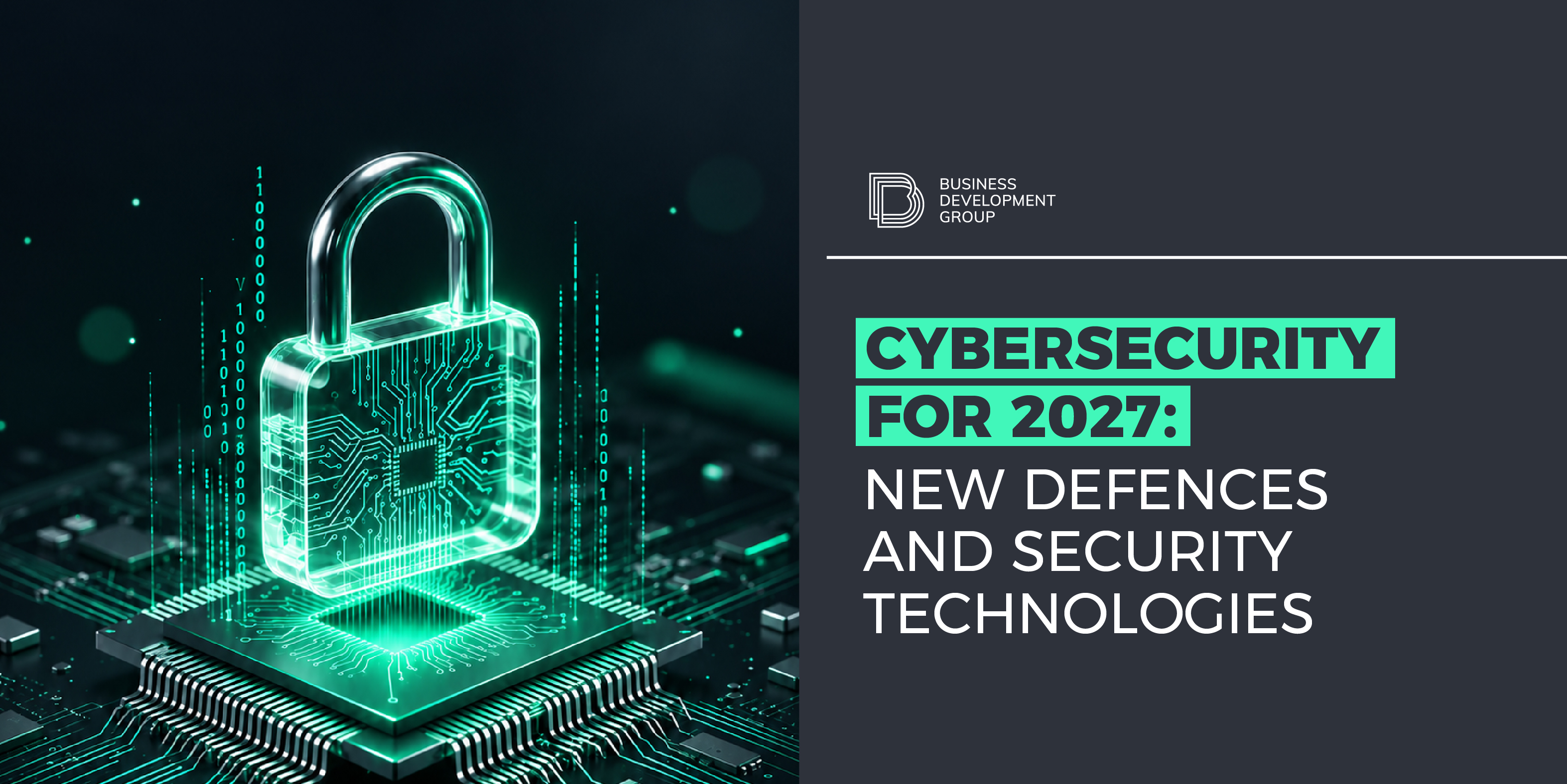
Cybersecurity for 2027: New Defences and Security Technologies
The digital world is at an unprecedented moment. The report published by World Economic Forum entitled "Cybersecurity's Strategic Inflection Point: A Senior Leadership Agenda for 2027″ clearly maps out the risks, challenges, and opportunities that organizations globally will face in the coming years. We are no longer talking about cybersecurity as an isolated technical department, but about a strategic business function, integrated into the decision-making core of any modern organization. CEOs, boards of directors and top leaders can no longer fully delegate this responsibility to IT teams. Cyber threats have evolved so rapidly that they have outpaced traditional response capacity, transforming into a systemic risk with major economic, geopolitical and social implications.
The Threats of Cybersecurity for 2027
As businesses continue to accelerate digital transformation, the cybersecurity landscape is becoming more complex and dangerous. As we are about to enter 2027, we feel it is important to begin looking ahead to the threats that businesses will face. These threats include increasingly sophisticated attacks fueled by artificial intelligence, interconnected supply chains, and evolving cybercriminal tactics.
1. AI-Powered Cyberattacks
AI is rapidly becoming a weapon for cybercriminals. Attackers are using AI to automate vulnerability discovery, create convincing phishing emails, generate malicious code, and conduct highly targeted social engineering campaigns. The result is faster, more personalized, and harder-to-detect attacks. The World Economic Forum reports that AI is viewed as the most significant driver of change in cybersecurity, with organizations concerned about both AI-enabled attacks and vulnerabilities within AI systems themselves.
2. Advanced Phishing & Deepfake Fraud
Traditional phishing emails are evolving into sophisticated attacks that leverage generative AI, deepfake voice cloning, and realistic video impersonation. Criminals can now mimic executives, vendors, or trusted partners to deceive employees into transferring funds or sharing sensitive information. As these technologies become more accessible, businesses should expect a significant increase in business email compromise (BEC) and identity-based fraud attempts.
3. Ransomware & Cyber Extortion
Ransomware remains one of the most costly and disruptive cyber threats. Modern ransomware groups are moving beyond simple encryption tactics to “double” and “triple extortion” models that include data theft, public exposure threats, and attacks against third parties. Government agencies such as CISA continue to identify ransomware as a major threat to organizations of all sizes, particularly those with weak backup, monitoring, and incident response capabilities.
4. Identity & Credential-Based Attacks
Cybercriminals increasingly prefer to steal credentials rather than exploit software vulnerabilities. Once attackers gain access to valid usernames and passwords, they can often move through systems undetected. The rise of cloud computing, remote work, and Software-as-a-Service (SaaS) platforms has made identity the new security perimeter. Businesses that fail to implement multi-factor authentication, privileged access management, and Zero Trust security principles will face elevated risk in 2027.
5. Supply Chain & Third-Party Risks
Organizations are more interconnected than ever, relying on vendors, cloud providers, managed service providers, and software partners. Cybercriminals increasingly target these trusted relationships because compromising a single supplier can provide access to many organizations simultaneously. The Global Cybersecurity Outlook 2026 highlights supply chain security as a growing concern, while industry research continues to identify third-party compromise as a significant contributor to cyber incidents.
The top cybersecurity threats of 2027 will be defined by automation, identity compromise, and expanding digital ecosystems. To remain resilient, businesses should invest in employee awareness training, multi-factor authentication, continuous monitoring, incident response planning, and robust third-party risk management programs. Organizations that proactively strengthen their cyber defenses today will be far better positioned to withstand tomorrow’s threats.
5 Cybersecurity Trends that will Reshape CISO Priorities
The cybersecurity trends that will define 2027 are already visible in the data: agentic AI security, the AI-driven SOC, third-party exposure, postquantum deadlines, and boards that want security measured like any other investment.
The following five trends share a weak point. Each one assumes the controls that are working. Agents need governed identities, AI-driven SOCs need reliable signals, and boards need proof. None of that holds if a policy was quietly switched off.
Trend 1: Securing AI agents becomes an identity problem
Gartner puts agentic AI at the top of its 2026 cybersecurity trends. Director Analyst Alex Michaels said security leaders need to track every AI agent in use, both approved and unapproved. Gartner also says identity and access management must adapt to AI agents (Gartner). It goes further in a newer forecast: by 2029, more than half of successful attacks on AI agents will exploit weak access controls and prompt injections (Gartner).
Attackers are already going after AI access. IBM X-Force found that info stealer malware exposed more than 300,000 ChatGPT credentials in 2025 (IBM X-Force). And 35% of security leaders now list agentic AI among their top budget priorities (PwC).
As AI agents get permission to read data and act for users, access rules, identity policies, and logging become AI controls. CISOs will need ongoing proof that these controls stay switched on as the number of agents grows.
Trend 2: The AI-driven SOC changes the job, not just the tools
Gartner warns that AI in the SOC is disrupting how teams work. It urges leaders to "prioritize people as much as technology" and to keep humans checking AI-supported decisions (Gartner). Nearly half of security leaders (48%) are prioritizing AI-powered threat hunting (PwC).
The people side is harder. In Gartner's 2026 CISO survey, 52% of leaders working on AI said they lack the right skills, and 56% said things are changing too fast (Evanta, a Gartner company).
AI in the SOC is also only as good as the data it gets. If an endpoint agent stops reporting or an email rule is turned off, the AI sees less and finds less, and it won't tell you. Through 2028, the SOC teams that get the most from AI will be the ones that check the controls feeding it data and can see how the AI reached each conclusion.
Trend 3: Third parties become a top way in for attackers
Third parties were involved in 48% of breaches, a 60% increase, according to the 2026 Verizon Data Breach Investigations Report (Verizon). IBM X-Force counted 49% more active ransomware and extortion groups than the year before (IBM X-Force). CISOs say ransomware and supply chain resilience are still their biggest worries (World Economic Forum, Global Cybersecurity Outlook 2026).
These numbers will turn continuous threat exposure management from a slide-deck framework into a daily requirement. Partners connect through identity, email, and web controls, and these are the controls most likely to slip when vendors are added in a rush. You can only prioritize new risks if you know which defenses are actually working.
Trend 4: Postquantum cryptography and regulation shorten planning time
Gartner warns that quantum computing could break the encryption most organizations rely on by 2030. It also names fast-changing global regulation as a key trend (Gartner). Most organizations aren't ready: 49% haven't yet considered or started quantum-resistant security (PwC).
For North American companies with global operations, 2030 is closer than it seems. Inventorying cryptography, getting vendor commitments, and planning a migration all take years. Meanwhile, auditors and regulators will want up-to-date proof of control status, mapped to frameworks, not a report put together once a year.
Cyber Vigilance 360 doesn't inventory cryptography. But it does help here: it continuously maps controls to MITRE ATT&CK and CIS Controls, so producing that proof becomes a quick, routine task.
Trend 5: Security gets measured like any other business investment
Most security budgets are still growing. 78% of organizations expect their cyber budget to rise over the next 12 months (PwC). But security is getting a smaller slice of IT spending, falling from 11.9% to 10.9% in 2025 (IANS Research).
There is also a gap in what leaders worry about. The World Economic Forum found that CEOs rank cyber-enabled fraud as their top concern, while CISOs focus on ransomware and supply chain risk (World Economic Forum). Closing that gap takes board-ready security reporting that ties posture, coverage, and license use to business risk in terms both sides recognize. Cyber posture intelligence, meaning a continuous, scored view of whether defenses work, is how CISOs will make that case.
The threats and trends in this article point in the same direction. Attackers are using AI to move faster and look more convincing. They are stealing credentials instead of breaking in, and they are reaching companies through their vendors and partners. At the same time, defenders are adding AI agents, AI-driven SOCs, and new frameworks to keep up.
All of this rests on one thing: security controls that actually work. AI agents are only safe if their identities and access are governed. An AI-driven SOC is only as good as the data its controls feed it. Third-party risk can only be managed if the defenses partners connect through are really in place. And regulators and boards will want current proof, not a yearly report.
The problem is that controls drift. A policy gets switched off, an endpoint agent stops reporting, or a vendor is onboarded in a rush. Usually nobody notices until something goes wrong.
That is why the CISOs best prepared for 2027 will be the ones who stop assuming their defenses work and start checking them continuously. A clear, scored, always-current view of security posture helps them catch gaps early. It also helps them prioritize the risks that matter and explain security to the board in business terms.
Cyber Vigilance 360 is built for that job: continuously validating that your controls are on, mapping them to MITRE ATT&CK and CIS Controls, and turning that into reporting your board can use. The threats of 2027 are already here. The time to confirm your defenses can handle them is now.