IT and Programming
·Offline New
Python Full Course (AI Powered)
- ✓ Python fundamentals
- ✓ Object-Oriented Programming (OOP)
- ✓ Telegram bot development and deployment
- ✓ Working with AI tools
Free consultation · Certificate on completion · Practical learning
Duration
4 months
Format
Offline
Starts
28.05.2026
Certificate
On completion
Payment
Monthly
Price
65,000 ֏
Program
- The Big Picture: What Python is, where it's used, and why it dominates automation, data, and AI
- Development Environment: Setting up Python, code editor, and terminal from scratch
- First Program: Writing and running your first Python script
- Data Storage: How programs remember and work with numbers, text, and true/false values.
- Type Conversion: Transforming data between different formats and handling common pitfalls.
- User Interaction: Taking input from users and building interactive scripts.
- Hands-on: Building a simple calculator from scratch.
- Comparison Logic: Teaching your programs to evaluate and compare values.
- Decision Structures: Making programs choose different paths based on conditions.
- Combined Conditions: Building complex decision logic with multiple rules.
- Hands-on: Building a login system with username and password validation
- Repetition with for: Automating repeated actions over sequences of data.
- Repetition with while: Running code until a specific condition is met.
- Loop Control: Stopping and skipping within loops for precise behavior.
- Hands-on: Building a number guessing game with hints and attempt tracking.
- Nested Loops: Loops inside loops; when they're needed and when to avoid them.
- Professional Patterns: Accumulator, search, counting, and flag patterns used in real-world code.
- Extended Practice: Building 3 mini-programs; ATM simulator, word counter, and a menu-driven app.
- Lists: Storing, organizing, and manipulating collections of data.
- Smart Shortcuts: Processing entire lists in a single line of code.
- Tuples: Working with fixed, unchangeable data collections.
- Hands-on: Building a shopping list manager with add, remove, sort, and search.
- Sets: Eliminating duplicates and comparing groups of data instantly.
- Dictionaries: Storing labeled data — the foundation of nearly every real application.
- Nested Data: Working with complex, layered data structures.
- Hands-on: Building a fully functional contact book.
- Reusable Code: Writing functions that can be called anywhere — the key to clean, professional code.
- Flexible Parameters: Making functions adaptable with different types of inputs.
- Code Organization: Splitting programs into separate, importable files.
- Hands-on: Refactoring the contact book into professional-quality modular code.
- Understanding Errors: Reading error messages and tracebacks like a professional.
- Graceful Recovery: Writing code that anticipates and handles problems instead of crashing.
- Debugging Techniques: Finding and fixing bugs faster using proven methods.
- Hands-on: Building a "bulletproof" calculator that never crashes regardless of input
- Text Manipulation: Searching, splitting, joining, replacing, and formatting text data.
- Professional Formatting: Creating clean, readable output for reports and displays.
- Pattern Matching: Finding specific patterns (emails, numbers, dates) inside text.
- Hands-on: Building a text analysis tool that generates formatted reports.
- The OOP Mindset: Modeling real-world things in code — the way professional software is built.
- Classes & Objects: Creating blueprints for data with built-in behaviors.
- Methods: Teaching your objects to perform actions.
- Hands-on: Building a bank account system with deposits, withdrawals, and transfers.
- Inheritance: Creating specialized versions of existing objects without rewriting code.
- Polymorphism: Same action, different behavior — writing flexible, adaptable code.
- Design Thinking: When to use classes vs. functions vs. simpler structures.
- Hands-on: Building a task management system with different task types and priorities.
- Project Planning: Breaking a real application into manageable tasks and pseudocode.
- Independent Build: Designing and building a complete task management app from scratch.
- Progress Review: Demo, feedback, and identifying areas for improvement.
- Git Fundamentals: Tracking every change in your code, the tool every developer uses daily
- GitHub Portfolio: Publishing your projects online and building a professional developer profile
- Dependency Management: Setting up isolated project environments and managing external libraries
- File Operations: Reading, writing, and manipulating text files and spreadsheets programmatically.
- File System Control: Organizing, renaming, moving, and searching files automatically.
- Task Automation: Replacing 2 hours of manual file work with a 5-second script.
- Hands-on: Building a log file cleaner that extracts errors and generates clean reports.
- JSON Fundamentals: Understanding the data format that powers the modern internet.
- Nested Data Processing: Navigating and extracting information from complex data structures.
- Data Persistence: Saving and loading application data between sessions.
- Hands-on: Upgrading the TODO Manager with permanent data storage.
- Database Concepts: Tables, rows, queries; how real applications store and organize data
- SQL Essentials: Creating, reading, updating, and deleting data with the world's most used database language
- Security Basics: Preventing common database vulnerabilities in your applications
- Hands-on: Rebuilding the contact book as a database-powered application
- API Fundamentals: How programs talk to each other across the internet
- Making Requests: Pulling live data from real-world services - weather, news, financial data
- Reading Documentation: Learning to work with any new API independently
- Hands-on: Building a tool that fetches real-time country information from a live API
- Secure Authentication: Working with API keys and protecting credentials
- Multi-Source Data: Combining data from APIs, files, and databases into unified datasets
- Data Transformation: Cleaning, filtering, and reshaping raw data into useful formats
- Hands-on: Building a weather tool with live data, search history, and export features
- Professional Interfaces: Adding command-line options, help text, and clean output to your scripts
- Design Patterns: Making tools intuitive and user-friendly for anyone, not just developers
- Project Packaging: Structuring and sharing tools so others can install and use them
- Hands-on: Building a CLI data dashboard with query, report, and export commands
- Domain Selection: Choosing a real-world domain: weather, finance, sports, or movies
- Pipeline Architecture: Designing a system that collects, stores, processes, and exports data
- Independent Build: Building a complete data pipeline with a professional command-line interface
- Mini Project #2 Review (Code review, showcase best solutions, lessons learned.)
- Email Automation (smtplib , constructing messages with email.mime , sending HTML emails, attachments. Using app passwords.)
- Report Automation (Generate reports from data (CSV/DB), format as text or HTML, email automatically.)
- Task Scheduling (schedule library, time.sleep() patterns, cron basics (Linux/Mac), Task Scheduler (Windows). When to use what.)
- Practice (Build: Automated daily report — queries data from DB, generates summary, sends email. Set up a schedule.)
- Bot Setup: Creating and configuring your own Telegram bot from scratch.
- Commands & Conversations: Teaching your bot to respond to messages and follow conversation flows.
- Connecting Python Logic: Wiring your bot to real functionality; weather, data lookups, calculations.
- Hands-on: Building a working utility bot that lives on your phone.
- System Architecture: Designing a bot that connects to multiple data sources and performs real actions.
- Independent Build: Building a full-featured Telegram bot; expense tracker, news digest, or task reminder.
- Progress Review: Demo, feedback, and architecture discussion
- How AI Works: Understanding AI models at a practical level, what they can and can't do.
- Prompt Engineering: The skill of getting precise, useful results from AI every time
- Effective Communication: Structuring requests to AI for classification, summarization, extraction, and generation
- Hands-on: Building a personal library of tested, effective prompts for different work scenarios
- AI Setup: Connecting to AI services securely from your Python scripts
- Sending & Receiving: Passing data to AI and getting structured, usable answers back
- Reliable Outputs: Ensuring AI gives you clean, parseable results you can use in your programs
- Hands-on: Building a tool that sends text to AI and gets back a structured analysis automatically
- AI as Your Coding Partner: Using tools like GitHub Copilot, Cursor, and Claude to write code faster
- AI-Powered Debugging: Finding and fixing bugs in seconds instead of hours
- Smart Workflow: Knowing when to use AI, when to code manually, and how to verify AI's suggestions
- Hands-on: Timed building challenge — experience the 3-5x speed difference firsthand
- AI for Text: Using AI to summarize documents, draft emails, translate, and classify content at scale
- AI for Data: Feeding raw data to AI and getting back insights, anomaly reports, and interpretations
- Multi-Step Workflows: Chaining AI tasks extract → analyze → generate → deliver
- Hands-on: Building a system that takes raw data, runs it through AI, and delivers a polished report
- Architecture Design: Planning an end-to-end system that uses AI to solve a real problem
- Independent Build: Building a smart chatbot, content writer, data analyzer, or AI-enhanced bot
- Progress Review: Demo, feedback, and optimization discussion
- AI Project Review: Showcasing and reviewing AI projects from Lesson 29
- Final Project Brief: Requirements, scope, and expectations for your graduation project
- Project Design: Choosing your problem, designing the architecture, defining features, and getting instructor approval
- Check-in (Where is everyone? Review progress. Identify blockers.)
- Build Time (Core Features) (Students work on MVP — the core functionality that makes their project work. Instructor rotates through students.)
- Group ProblemSolving (Common issues raised and solved together. Students help each other — builds collaboration skills.)
- Build Time (Continue) (Continue building. Target: core features working by end of session.)
- Feature Polish: Handling edge cases, improving error handling, and completing secondary features
- Code Quality Workshop: Live code review: learning to write clean, professional, maintainable code
- Documentation: Writing clear README files and usage examples for your project
- Peer Testing: Students test each other's projects and report bugs
- Final Fixes: Resolving bugs, handling edge cases, and finalizing all features
- Final Code Review: Instructor reviews code quality, structure, and documentation before final submission
- Portfolio Polish: Final cleanup of all GitHub repositories making every project presentable
- Developer CV: Building a technical resume and optimizing your LinkedIn profile
- Job & Freelance Market: Where to find work, what employers expect, and how to land your first role
- Learning Roadmap: What to learn next based on your chosen career path: backend, data, or advanced AI
Why Join the Course?
Why join the “Python Full Course (AI Powered)”?
This course provides a solid foundation in Python and opens new opportunities for those looking to enter the programming field.
Participants will also have the opportunity to work with AI agents and understand how they are applied in real-world projects.
The course is designed for individuals interested in programming and modern technology trends. It is especially valuable for those who recognize how AI is transforming the way developers work—and want to learn how to integrate and leverage it to achieve practical, market-relevant results.
By the end of the course, participants will be able to write clean and structured code, work with APIs, build Telegram bots, and implement automation systems. All of this is enhanced through AI tools, enabling faster, higher-quality, and more efficient outcomes.
After completing the course, participants can pursue roles such as Python Automation Specialist, AI Integration Specialist, Telegram/Chatbot Developer, Data Analyst, or Junior Backend Developer.
Get 5% Cashback
Pay with  QR Code
- 1 Pay the tuition by bank transfer in your own name.
- 2 Receive the electronic settlement document confirming the payment.
- 3 File your annual income declaration and include the tuition expense.
- 4 Once approved, the amount is refunded to your bank account.
Who is this course for
-
✓
Students / Beginners entering the field of programming
Students from programming or related fields who lack practical experience and up-to-date knowledge can join this course. It provides the essential skills required by today’s job market.
-
✓
Current developers
The course is also designed for developers who want to learn a new language, explore new techniques, and work with Python-based tools.
-
✓
Professionals from related fields
Specialists working in adjacent areas such as data analytics, project management, and similar fields can also benefit from this course.
What you will learn
- ✓Python fundamentals
- ✓Object-Oriented Programming (OOP)
- ✓Telegram bot development and deployment
- ✓Working with AI tools
- ✓Building projects using AI tools
Ready to join this course?
Secure your place and take the next step in your professional growth.
Frequently asked questions
Each course is labelled beginner, intermediate or advanced. If you are unsure, book a free consultation and we will help you choose.
Flexible payment options are available for most programs. Contact us to discuss the right plan for you.
We mostly hold trainings with a Project Based Learning approach. Thanks to this approach, the students gain practical knowledge and develop their proficiency in the most efficient way.
After each training the students pass exams. Thus, both students and trainers have the opportunity to clearly assess the effectiveness of the training. Based on the results of the exams the students get certificates.
Upon completion of the training we give certificates to our students. Moreover, those whose performance is above 80% receive certificates of excellence.
We have developed a partner network that includes current best employers. In cooperation with them we do our best to assist our students in finding jobs. This network also helps us to organise internships for our students after the trainings.
Payment for the courses is made after the first lesson until the second lesson, in cash or by transfer. Payment for each stage is made for a fixed amount of 8 lessons.
Our courses are held in 2 main formats: online and offline. We believe that maintaining the format is very important for the effectiveness of the course.
BDG classrooms are technically equipped, and if necessary, we also provide students with laptops.
There is a break during each course, during which you can have a coffee and tea break.
HR consulting is carried out with our Career Development Specialist. With him, you can discuss your CVs, make corrections and finalize them, ready to apply for jobs.
All course materials, including recordings, books provided by trainers and other educational materials, are constantly available to our students during the course.
Individual courses are not currently designed, based on market needs and demands. During group courses, participants are also actively involved in teamwork, develop their communication skills, and learn to work in a team.
There is no age limit as such, as we value the spread of education to all age groups. It is especially important for us that people who already have experience and knowledge and want to acquire a new profession also go into a new educational direction.
Admission to each course is carried out through an interview or a test, or both at the same time. The choice of admission method depends on the requirements and specifics of the course.
We provide technical support to all our students related to the operational work of computers, as well as technical issues. The support is provided by our employee within the framework of the course.
Our team is in constant contact with students to provide the information you need, if necessary.
Certificates
Certificates you can receive
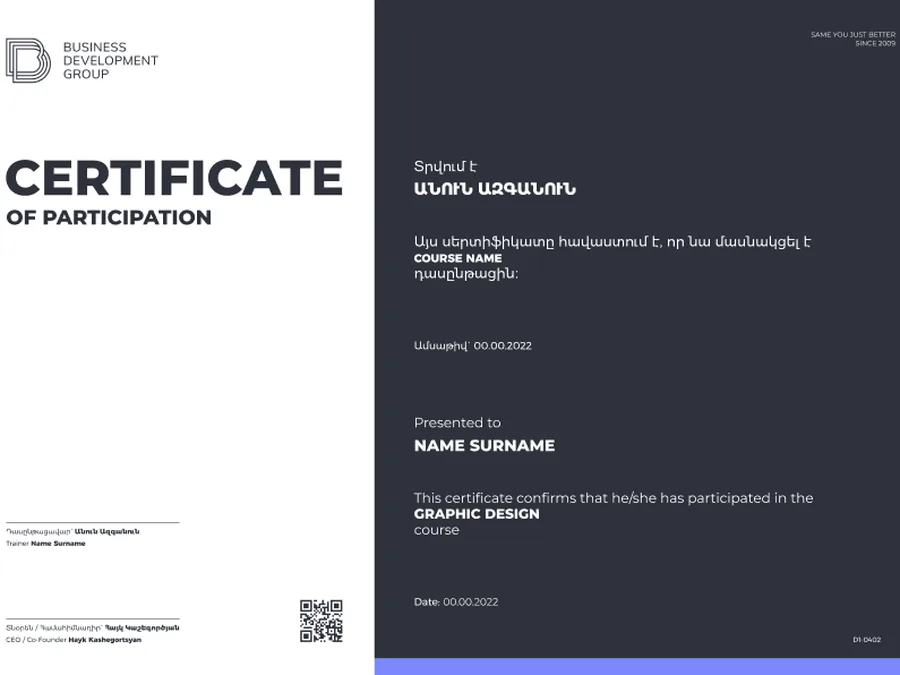
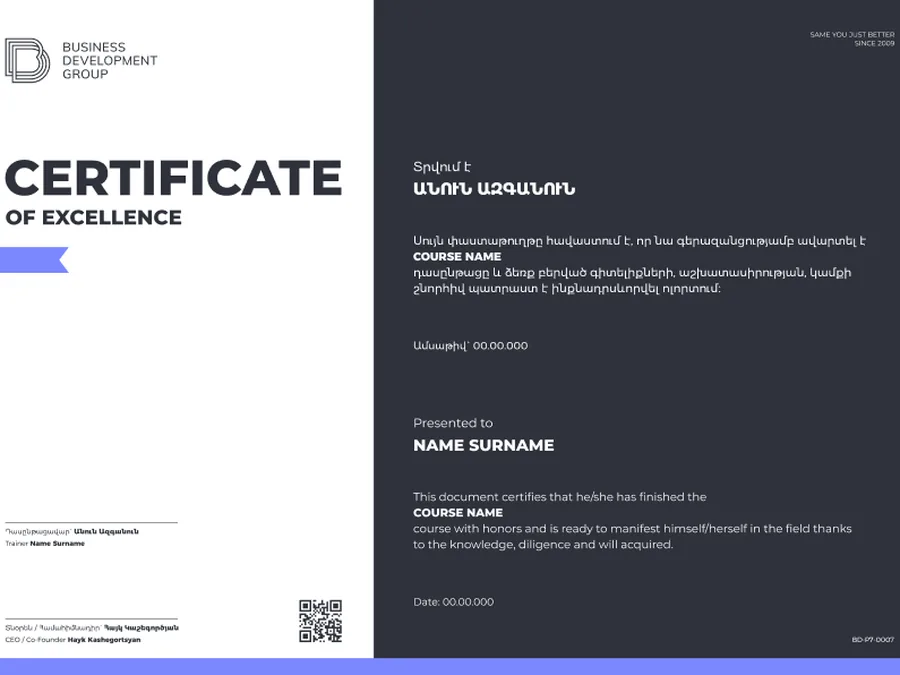
Depending on the course format and results, students can receive one of BDG's certificate types.
- ✓ Verified BDG certificate
- ✓ QR / signature-ready format
- ✓ Armenian & English certificate design
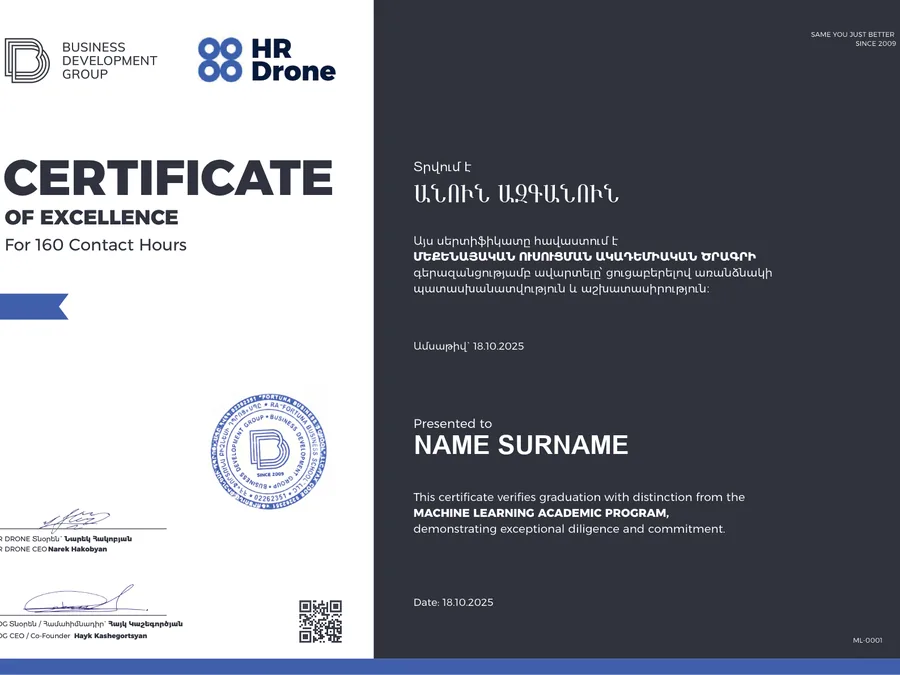 Co-branded
Participation
For students who actively participate in the course learning process.
For active participationCompletion
For students who complete the course requirements and finish the program.
For successful completionExcellence
For students who complete the course with outstanding results and strong performance.
With distinctionHR Drone
A co-branded certificate for selected HR and partner-certified programs.
Co-brandedIT and Programming
Ready to start Python Full Course (AI Powered)?
Book a free consultation and reserve your place in the next cohort.
65,000 ֏
4 months · Starts — May 28, 2026
Keep exploring
Related courses