Career Advice
Get practical guidance on career growth, job search, interviews, CV improvement, and the next steps in your professional path.
Free consultation · Certificate on completion · Practical learning
Duration
2 months
Format
Offline
Starts
23.10.2026
Certificate
On completion
Lessons
16 lessons
Price
65,000 ֏ / month
Schedule
At BDG, learning continues beyond lessons. You get access to guidance, community, events, spaces, and resources that support your professional growth.
Get practical guidance on career growth, job search, interviews, CV improvement, and the next steps in your professional path.
Learn how to present your skills, build professional visibility, and create a stronger personal brand in your field.
Join free webinars, seminars, and open sessions every month to keep learning, meet experts, and discover new opportunities.
Become part of a large professional community of students, graduates, trainers, and industry specialists.
Use BDG spaces for learning, networking, teamwork, and focused work when you need the right environment to grow.
Access useful books, materials, guides, and learning resources selected to support your development.
This course will equip you to start a career as a business analyst and become a competitive professional in the IT industry.
The curriculum reflects the skills and expectations of today’s job market. During the course, you will learn to:
Define and analyze business problems by understanding business needs, objectives, and the value of the proposed solution.
Understand the business analyst’s role throughout the software development lifecycle and work with different development approaches.
Identify and analyze stakeholders, mapping their needs, expectations, and influence on the project.
Conduct business and domain research, and plan and conduct interviews to elicit requirements.
Write user stories, acceptance criteria, and use cases to communicate requirements clearly to the team and assess whether the solution meets them.
Define the MVP scope, set priorities, organize the backlog, and maintain requirements traceability.
Model business processes, create wireframes and interactive prototypes, and validate requirements and proposed solutions with stakeholders.
Assess risks and review requirements to ensure they are clear, complete, and aligned with actual business needs.
Apply AI in business analysis, verify its outputs, identify unsupported assumptions, and protect data confidentiality.
Get 5% Cashback
Pay with easywallet QR Code
Beginners
For those who want to enter the field of business analysis and learn the fundamentals of a business analyst’s work.
Career changers
For those who want to apply their existing experience in a new field and develop business analysis skills.
Working professionals
For business analysts and professionals in related roles who want to consolidate their knowledge, strengthen their business analysis skills, and adopt new tools.
Students and recent graduates
For those who want to gain practical skills and prepare for their first role in business analysis.
Professionals from other fields
For project and product managers, QA specialists, developers, and other professionals whose work involves analyzing business problems, understanding requirements, and contributing to the development of digital solutions.
Understand the BA role, business needs and value, with an introduction to IIBA and BABOK
Set up ChatGPT Projects and explore Memory and model choice for BA work
Begin the CRM case by separating facts, assumptions and discovery questions
Explore business problems and possible causes using 5 Whys
Define objectives, scope, constraints and success measures in a project brief
Create a short BA master prompt to support analysis throughout the course
Explore SDLC phases and the BA contribution from discovery through release and operation
Understand collaboration, testing, training, data migration and outcome measurement
Map the CRM project lifecycle and connect analysis outputs across its stages
Compare Waterfall, Agile and Lean approaches to software delivery
Explore Scrum responsibilities, backlogs, sprints and increments
Choose a delivery approach for the CRM case based on value, uncertainty and trade-offs
Identify stakeholders and assess their influence, interest and engagement needs
Use stakeholder mapping and a RACI matrix to clarify involvement and responsibilities
Practice stakeholder conversations and build a communication plan for the CRM project
Define research questions and use ChatGPT Deep Research and source-based analysis
Evaluate evidence quality and bias, and verify AI-generated claims
Turn CRM research findings into stakeholder questions and discovery inputs
Choose elicitation methods and practice clear, neutral interview questions
Explore gap analysis, business rules analysis and simple decision tables
Prepare a CRM elicitation plan and interview guide with AI-assisted review
Run a CRM discovery workshop using interviewing, facilitation and structured note-taking
Analyze incomplete or conflicting information and check AI summaries against source notes
Document stakeholder needs, candidate rules and questions requiring follow-up
Distinguish business, stakeholder, solution and transition requirements
Separate requirements from assumptions, rules and design ideas, and link them to evidence
Create a lightweight Business Requirements Document (BRD) for the CRM project
Define system behavior and business rules alongside quality needs such as usability and security
Write clear, consistent and testable functional and non-functional requirements
Improve CRM requirements through peer review and AI-assisted quality checks
Write user stories and testable acceptance criteria, including Given–When–Then
Develop use cases with main, alternative and exception flows
Identify missing scenarios and select an appropriate level of requirements detail
Define the minimum viable product (MVP) and prioritize scope using value, effort and risk
Organize requirements and backlogs, and manage their lifecycle and changes
Maintain traceability from business goals to requirements, acceptance criteria and validation
Model current and future processes using flowcharts and basic BPMN
Explore UML use case, activity and sequence diagrams and when to use them
Link models to requirements and rules, and review AI-generated diagrams and interactive views
Research user experience patterns and create user flows and wireframes for the CRM case
Use AI to build or adapt a focused interactive prototype based on validated needs
Test the flow through peer walkthroughs and refine it using observed results
Identify and assess risks, track assumptions and issues, and plan risk responses
Explore verification and validation and create User Acceptance Testing (UAT) scenarios
Check AI-generated analysis and apply responsible data-handling practices
Apply the BA lifecycle to a new CRM change request and assess its value, scope and risks
Present your recommendation and complete an individual assessment
Review your connected BA portfolio and reflect on AI use and professional judgment
Secure your place and take the next step in your professional growth.

Lead Business Analyst
Yervand has always been interested in economics, information technology, and process automation. When he discovered the role of a business analyst, he realized that it brought all three interests toge...
Each course is labelled beginner, intermediate or advanced. If you are unsure, book a free consultation and we will help you choose.
Flexible payment options are available for most programs. Contact us to discuss the right plan for you.
We mostly hold trainings with a Project Based Learning approach. Thanks to this approach, the students gain practical knowledge and develop their proficiency in the most efficient way.
After each training the students pass exams. Thus, both students and trainers have the opportunity to clearly assess the effectiveness of the training. Based on the results of the exams the students get certificates.
Upon completion of the training we give certificates to our students. Moreover, those whose performance is above 80% receive certificates of excellence.
We have developed a partner network that includes current best employers. In cooperation with them we do our best to assist our students in finding jobs. This network also helps us to organise internships for our students after the trainings.
Payment for the courses is made after the first lesson until the second lesson, in cash or by transfer. Payment for each stage is made for a fixed amount of 8 lessons.
Our courses are held in 2 main formats: online and offline. We believe that maintaining the format is very important for the effectiveness of the course.
BDG classrooms are technically equipped, and if necessary, we also provide students with laptops.
There is a break during each course, during which you can have a coffee and tea break.
HR consulting is carried out with our Career Development Specialist. With him, you can discuss your CVs, make corrections and finalize them, ready to apply for jobs.
All course materials, including recordings, books provided by trainers and other educational materials, are constantly available to our students during the course.
Individual courses are not currently designed, based on market needs and demands. During group courses, participants are also actively involved in teamwork, develop their communication skills, and learn to work in a team.
There is no age limit as such, as we value the spread of education to all age groups. It is especially important for us that people who already have experience and knowledge and want to acquire a new profession also go into a new educational direction.
Admission to each course is carried out through an interview or a test, or both at the same time. The choice of admission method depends on the requirements and specifics of the course.
We provide technical support to all our students related to the operational work of computers, as well as technical issues. The support is provided by our employee within the framework of the course.
Our team is in constant contact with students to provide the information you need, if necessary.
Certificates
Depending on the course format and results, students can receive one of BDG's certificate types.
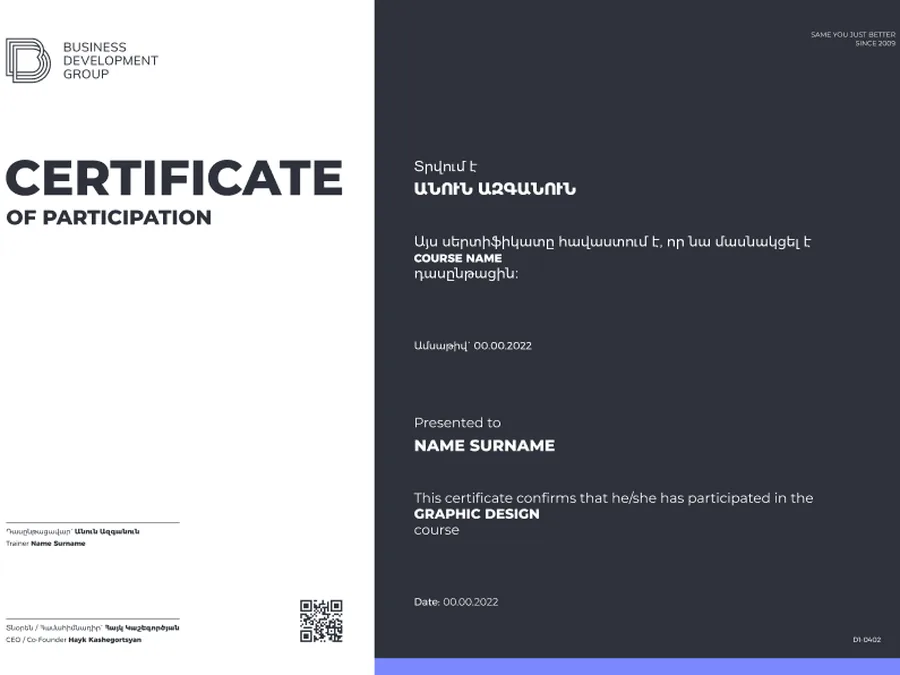
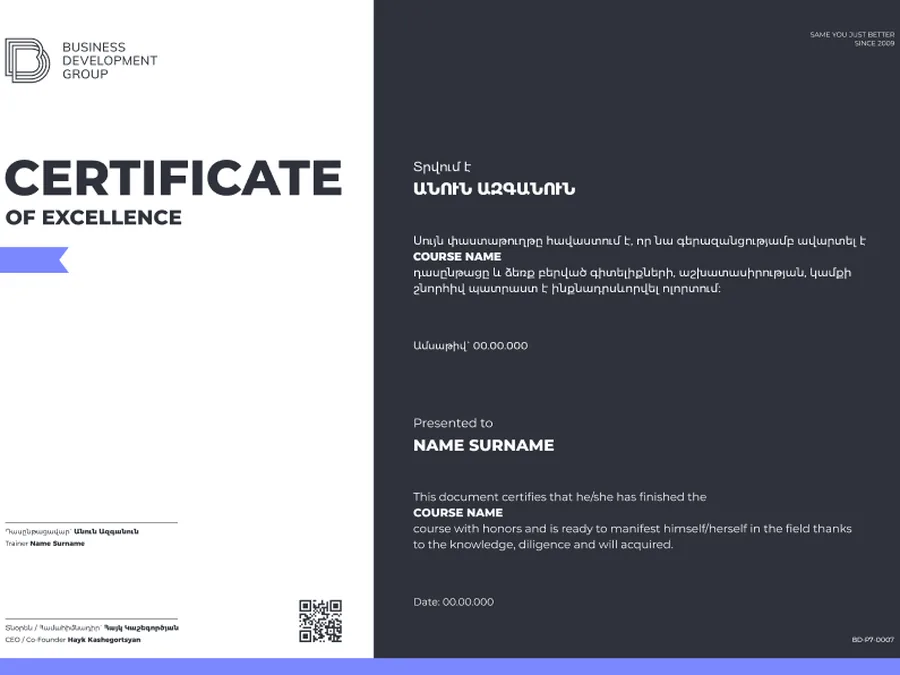
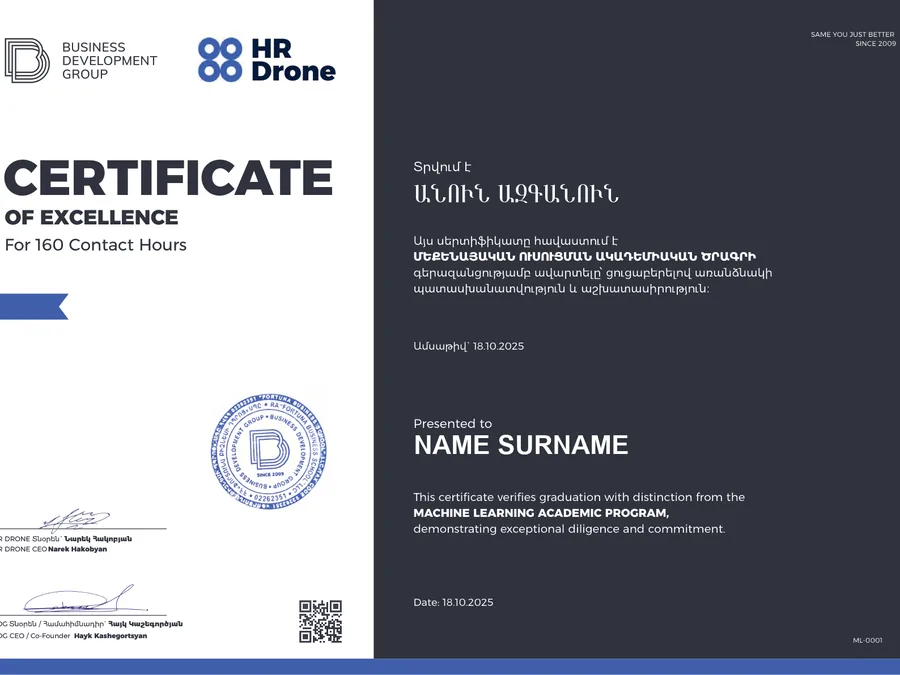 Co-branded
For students who actively participate in the course learning process.
For active participationFor students who complete the course requirements and finish the program.
For successful completionFor students who complete the course with outstanding results and strong performance.
With distinctionA co-branded certificate for selected HR and partner-certified programs.
Co-brandedManagement
Book a free consultation and reserve your place in the next cohort.
2 months · Starts — October 23, 2026
81% booked